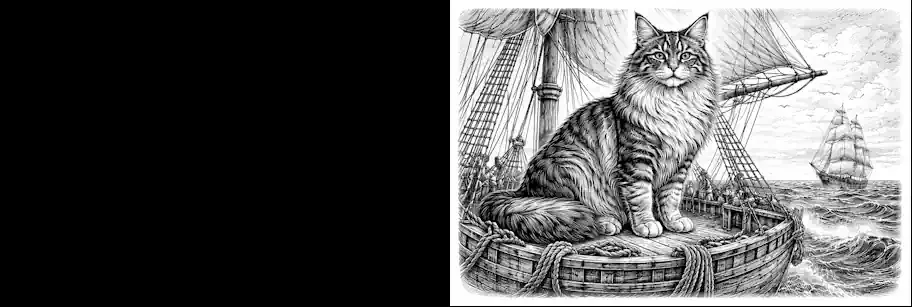
This is a three part fiction tale about a Maine Coon Cat told in the first person by the cat about his sea voyage to Maine and finding and establishing a home and family. Enjoy!
My name is not important, though it has been spoken with urgency on several occasions, usually when gravity is involved. For the sake of order, you may call me what the crew does when they wish to believe they are in command. I answer to it when convenient. I am Harry!
I am a Maine Coon of respectable dimensions and deliberate movement. I was not consulted about this voyage. I was placed upon the deck one morning in a crate that smelled faintly of pine and badly of optimism, and the matter was considered settled. The men spoke of necessity. They always do. There were rats in the hold, they said, as if rats were a sudden revelation and not a permanent clause in the contract between wood and grain.
The ship itself is an earnest construction. It creaks with conviction. It lists slightly even when tied to the dock, as though rehearsing for future embarrassment. The planks swell and contract like a man attempting to appear larger than he is. I walked its length before departure and found that it possessed more confidence than balance. This is common in vessels and in men.
They refer to me as “ship’s cat,” which suggests a title conferred after committee review. I did not apply. I inspected the hold instead. It is dark there, and damp, and layered with the quiet calculations of creatures who believe no one is watching. The rats conduct their affairs with the gravity of minor politicians. They have built tunnels through sacks of grain with admirable persistence. I admire persistence, though I do not reward it.
Above deck, the crew moves with theatrical urgency. Ropes are hauled. Barrels are secured. Orders are issued in tones that imply the sea respects volume. It does not. The sea lies beyond the dock, flat and reflective, offering no opinion. That will change, I am told. I do not doubt it.
A man with a red beard attempted to introduce himself to me as if we were equals entering partnership. He extended a hand. I declined the arrangement by not acknowledging it. He laughed in a way that suggested he found me charming. This is a common misunderstanding.
When the ship finally pulled from the dock, the land did not protest. It simply receded. The crew stood in a cluster, watching the shoreline diminish, each of them privately certain that this journey would enlarge him in some meaningful way. I observed the horizon. It appeared cooperative at a distance and unreliable upon scrutiny.
Below, in the hold, the rats paused in their negotiations. They felt the shift before the men did. Wood under strain has a different tone when it commits to water. The floor adjusted beneath my weight. I adjusted in return. The didn't and now are fewer now.
I have been appointed, then, to maritime oversight. The rats will be addressed. The crew will exaggerate. The sea will conduct its own review in time.
I remain present.
The ship proceeds.
The machinery of water announced itself not with spectacle but with repetition. The deck rose and fell in a rhythm that suggested the sea was breathing through the hull, and the hull, for its part, pretended this was expected. Ropes tightened and slackened with small complaints. Lanterns swung in patient arcs, turning the men into elongated silhouettes who appeared more decisive in shadow than in daylight.
I moved along the starboard edge and considered the horizon. It has the habit of appearing stable while relocating itself with every step. A useful trait. The crew watched it as if it were a promise. I watched it as if it were a boundary that had not yet been negotiated.
Below deck, the hold had entered a new phase of argument. The grain sacks leaned into one another like uneasy jurors, and the rats adjusted their tunnels with bureaucratic efficiency. They are industrious creatures. They resent interruption. So do I.
The ship groaned at intervals, each complaint issued from a different beam or joint, as though the vessel were conducting internal litigation. I listened carefully. Wood reveals its anxieties in tone. The pitch was not yet desperate. Merely irritated. The sea was testing signatures.
A young sailor, barely old enough to distrust his own balance, attempted to walk the deck with the confidence of someone who believes the floor owes him cooperation. He took three steps before the ship corrected him. He recovered with theatrical dignity and glanced about to see who had witnessed the negotiation. I had.
He believes he is learning.
The ropes overhead swayed like suspended verdicts. Sails strained against wind that was not yet hostile but had opinions forming. The air smelled of salt and tar and ambition. I have found that ambition travels well by sea. It also dissolves easily.
In the hold, I encountered a delegation of rats near the aft storage crate. They froze when they saw me, as if collective stillness might rewrite reality. It did not. We regarded one another in silence. Their calculations were rapid. Mine were settled.
The arrangement changes nothing.
Above, the captain paced with a chart in hand, tapping it with one finger as though the inked lines would clarify themselves under pressure. The sea, visible beyond him, declined to confirm or deny the drawing. Charts are persuasive in dry rooms. Less so when the floor tilts.
The deck rolled slightly more to port. A barrel shifted. A sailor cursed in a tone usually reserved for betrayal. The lantern light wavered and settled again, restoring the men to their elongated forms. For a moment the ship resembled a narrow chapel in motion, each crewman a minor saint of rope and sweat, praying to wind through labor.
I sat at the base of the main mast and wrapped my tail around my paws. The vibration through the wood was steady. Not yet accusation. Merely reminder.
The machinery of water does not hurry. It repeats.
So it proceeds.
The audit arrived without trumpet or warning. The sea did not raise its voice. It simply withdrew its earlier courtesy.
The first change was in the wind. It ceased to negotiate and began to instruct. Sails snapped like documents being torn in half. The ropes, so recently decorative, became veins under strain. The ship leaned harder to port, reconsidered, and leaned the other way as if embarrassed by the display.
The crew abandoned subtlety. Orders were shouted now, each man convinced that volume might persuade physics. The captain’s chart vanished into a coat pocket, its lines suddenly decorative. Buckets appeared. Knots were tied with urgent fingers. A man crossed himself with the efficiency of habit rather than faith.
I moved lower, toward the center of the vessel where balance is less theatrical. The deck under my paws no longer rolled; it lurched. Water struck the hull with the confidence of a creditor. Each impact sent a tremor through the beams, and the beams answered with deep, wooden complaints that suggested the ship had begun reconsidering its career.
Below deck, the rats were no longer conducting committee meetings. They were migrating. Their tunnels abandoned, their order dissolved, they scrambled along the seams of the hull, seeking elevation. It is remarkable how quickly hierarchy evaporates when the floor tilts.
The sea reviewed everyone.
A wave climbed the side of the vessel and struck across the deck, sweeping a coil of rope loose and flattening a sailor against the rail. He regained his footing with a noise that implied defiance. The water offered no rebuttal. It merely returned for another pass.
The lanterns had been extinguished. The light now came in fractured intervals, lightning tearing brief windows into the dark. In those flashes, the ship resembled a narrow chapel turned sideways, its congregation clinging to pews that were no longer horizontal. Faces were pale. Teeth visible. Eyes wide with calculations that did not add up.
I climbed onto a secured crate and watched.
There is a particular stillness required during such revisions. Panic expends energy without altering outcome. The crew moved as though wrestling an invisible opponent. The sea did not wrestle back. It pressed.
The young sailor from earlier attempted to secure a flapping line. He misjudged the timing. The rope snapped free and struck the mast with a crack that silenced him more effectively than advice. He recovered. Slower now.
He believes this matters.
The ship shuddered with a force that suggested temporary regret. For a moment, I considered the angle of escape should wood decide to separate from itself. The decision tree was simple: height first, then flotation. I prefer contingency to prayer.
Hours, or something resembling hours, passed in cycles of assault and adjustment. The crew bailed, tied, shouted, braced. The captain no longer tapped charts. He gripped the wheel with the stubbornness of a man who has invested too much in the idea of direction.
Gradually, the impacts lessened. The wind shifted from command to complaint. The deck resumed a rolling motion that, while undignified, was survivable. The ship had not triumphed. It had endured.
The sea recorded the attempt and moved on.
I descended from the crate and inspected the hold. Grain was soaked. Tunnels collapsed. The rats had relocated to higher beams, their earlier confidence washed into anonymity.
The hierarchy adjusts.
The storm concluded its review. The ship remained.
So do I.
Land does not announce itself with gratitude. It appears.
By morning the sea had resumed its earlier impersonation of civility. The deck rolled with familiar hesitation rather than accusation. The sails hung in damp folds like garments after an argument. The crew moved slowly, as though each man were reacquainting himself with gravity.
A faint line on the horizon thickened into shape. Shore. Low hills. A scatter of buildings that looked provisional, as if they had been placed there to test the concept of permanence. The captain stood straighter. He adjusted his coat. He resumed the expression of a man who had predicted the outcome all along.
They will tell this differently by evening.
The young sailor spoke loudly of the wave that nearly took him, though in his version the wave retreated out of respect. Another man described the wind as cunning, as if weather were a rival officer with poor manners. The red-bearded one laughed in intervals that suggested bravery had been evenly distributed.
I listened.
My own account is shorter.
The wood held. The ropes held. The sea applied pressure and withdrew it. No medals were issued.
As the harbor approached, the ship adopted a new posture. It straightened slightly, as though eager to present itself for inspection. The men cleaned surfaces that had survived the storm without assistance. Buckets of seawater were thrown across the deck to remove evidence that would, in any case, be discussed proudly in taverns before nightfall.
In the hold, the rats had reorganized. They resumed their excavations with diminished arrogance. Their tunnels now curved toward beams rather than sacks. They have learned something. It will not last.
We entered the harbor at a measured pace. Smaller boats crossed before us with casual indifference. Onshore, figures gathered to observe arrival. They saw masts, canvas, men. They did not see the audit.
When the gangplank lowered, the crew stepped onto solid ground with exaggerated care, as if the earth itself might sway in retaliation. Laughter followed. Relief disguised as humor. The red-bearded man clapped another on the shoulder and declared the voyage a triumph.
He believes this.
I remained aboard a moment longer and regarded the dock. It did not move. It did not breathe. It did not test.
Eventually I descended.
On land, my title will expand. “Storm-tested,” they will say. “Sea-hardened.” The story will accumulate decoration. I will be credited with vigilance I did not advertise. Someone will claim I faced the gale with regal composure. This is inaccurate. I simply adjusted.
The harbor smells of fish and rope and fresh exaggeration.
The ship will sail again. The sea will conduct further reviews. The men will continue to narrate themselves upward.
As I stepped onto the dock, I heard one of the men remark that we had made port in a place called Maine. He said it with the tone of a man announcing the end of inconvenience. Maine. The word had weight to it. It sounded less like a gamble and more like a boundary. Cold air moved differently here—clean, deliberate, unhurried. The wind did not shove. It inspected.
I paused at the edge of the planks and studied the treeline beyond the harbor. Tall pines. Solid ground that did not lurch beneath negotiation. Snow still clinging in shaded places as if permanence were an acceptable habit. The sea, for all its instruction, had never promised consistency. This land at least appeared to believe in its own edges. If one must supervise a territory, it may as well be one that remains where it is put.
Maine, then.
It seems a steadier wager than water and winter is coming.