I noticed it because I was wasting time in the same room.
That’s usually when the good things happen, when you’re pretending to be busy and the cat is pretending not to watch you. The jump used to happen behind me, a familiar sound, a soft confident thud followed by the faint rustle of fur settling into victory. The back of the couch had always been hers. She took it in one smooth movement, no warm-up, no reconsideration, the way you step onto a stair you’ve climbed a thousand times and never look at.
This time she paused.
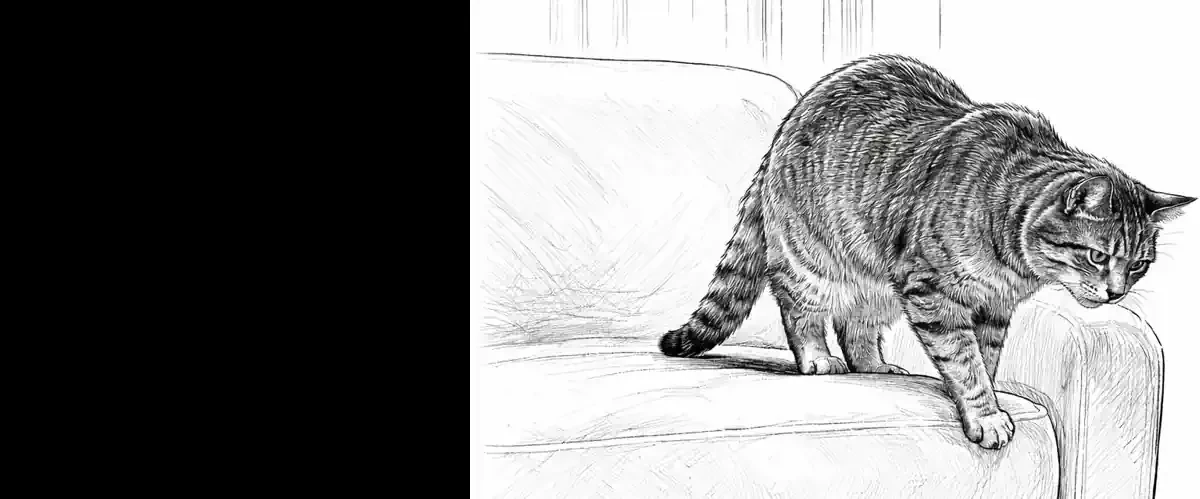
Not dramatically. No suspense music. Just a brief stop, the kind that feels longer because nothing usually interrupts there. She stood facing the couch, head slightly tilted, eyes fixed on the ledge as if it had quietly raised itself overnight.
She wasn’t scared. She wasn’t confused. She was doing math, and I had the odd feeling that I was part of the problem, standing there adding variables. Hard to tell.
She jumped anyway.
She came up short, not enough to fall, just enough to offend. There was a quick scramble, a flash of irritation, claws grabbing fabric like punctuation marks, and then she was up. She sat exactly as she always did, spine straight, tail wrapped neatly, face calm. If the miss mattered, it mattered to me. She did not bring it with her.
I waited for something else. A look back. A moment of reconsideration. An apology, which is ridiculous because cats don’t apologize and also because nothing actually went wrong. She had already moved on. The jump was finished. The information was stored somewhere I don’t have access to.
A few days later she didn’t jump at all.
She stepped onto the arm of the couch instead, then onto the cushion, then up, breaking the journey into smaller pieces like a person who has learned something and sees no reason to make a speech about it. It was slower, yes, but it was also clearly better. She arrived at the same place without fuss and arranged herself like she always had, as if this had been the plan all along.
She looked at me once, briefly, not for permission, not for reassurance, more like checking whether I was paying attention. I was, though I wasn’t sure what I was supposed to do with it.
People like to say cats are creatures of habit. This is comforting, especially to people who confuse repetition with loyalty. What cats actually do is adjust. Habit is just adjustment that hasn’t been challenged yet. When it stops working, they don’t argue with it. They don’t romanticize the old way. They change the route and keep the destination.
I wanted to call it aging. I wanted to attach a feeling to it, maybe sadness, maybe the start of something serious and heavy that I could point to later and say this was when it began. Humans are very good at telling those stories early. She offered none of that. Her body changed the rules. She adapted. Her sense of herself stayed exactly where it was.
She curled up, eyes half closed, breathing even, entirely at home. The jump had been replaced, not lost. Hard to tell
Probably, maybe!
Once you see it, you start seeing it everywhere, which is usually where people go wrong. I did too. I began watching her like I was auditing a system, looking for patterns, waiting for confirmation that this one change meant something larger. Cats are very good at exposing that impulse and then ignoring it.
Her day didn’t shrink all at once. It adjusted in small, almost polite ways. She still wanted the same things. The window. The chair. The patch of floor that caught the afternoon sun like it was scheduled just for her. What changed was how she got there and how much ceremony she was willing to invest along the way.
Weight does that first, quietly. Not enough that you notice until you really notice. A little more mass means a little more thought. Jumps become conversations instead of announcements. She stands there longer, not because she’s unsure, but because she’s deciding whether it’s worth the effort when there are other options that don’t involve proving anything. I recognize this. I do it too, just with stairs.
Injury makes the math obvious. A sore paw turns confidence into logistics. Certain routes disappear overnight. Not dramatically. They just stop being used, like a road closed for construction that nobody bothers to reopen. She doesn’t limp for sympathy or test the pain to see if it’s still there. She simply edits the map and carries on as if this was always the sensible version.
Slowness arrives the same way. Not as failure. As preference. She still plays, but briefly, intensely, and then she’s done. She still watches birds with professional interest, but she no longer feels obligated to sprint across the room just to demonstrate enthusiasm. Rest becomes part of the plan, not the thing you do afterward.
I kept waiting for a moment of recognition. Some sign that she noticed the change the way I did. She never offered one. She did not behave like a cat who used to be faster. She behaved like a cat who knows how her body works today.
That’s the part that unsettles me, I think. Humans collect versions of themselves and carry them around like reference manuals. Cats don’t archive. They operate. The day presents a set of conditions. The cat responds. Tomorrow might be different. That will be handled tomorrow.
What looks from the outside like limitation often feels, from the inside, like clarity. Fewer unnecessary movements. Fewer pointless risks. A cleaner use of energy. I call it slowing down. She calls it living efficiently, though she doesn’t call it anything at all.
Hard to tell
Probably more sadness coming for me.
There is a strange relief in realizing she does not know what she has lost.
Or maybe she knows and simply doesn’t care in the way I expect her to. That part is harder to sit with. I watch her move now with a kind of split attention, seeing what she does and what she no longer does at the same time. She does not share this problem. She moves once. Fully. No double exposure.
I keep waiting for grief to show up. A pause that feels heavy instead of practical. A moment where she seems to remember the old version of herself and feel something about it. It never arrives. What arrives instead is competence. She knows exactly how far she can stretch, how long she can play, when to stop before stopping becomes failure. It’s unsettling, watching someone adapt so cleanly.
Cats accept physical limits without emotionally acknowledging decline, which feels impossible if you’re human and vaguely self-aware. We narrate everything. We compare today to yesterday and yesterday to ten years ago and carry all of it around like extra luggage. She carries none of that. Her body tightens the rules and she loosens the story, and somehow both things are true at the same time.
This is where honesty and illusion meet, and neither one flinches.
She lives honestly inside what her body allows. She also behaves as if nothing essential has been taken away. The illusion isn’t denial. It’s continuity. She remains herself by refusing to argue with the terms of the day. There is no performance of bravery. There is no quiet tragedy unfolding for an audience. There is just a cat doing what works and doing it well.
I find this deeply unfair.
I would like her to acknowledge the change so I can file it somewhere and feel appropriate about it. I would like a signal that something has shifted and deserves to be marked. She offers none. She eats, sleeps, watches, chooses, adjusts. If there is sadness in the room, it belongs to me. She does not pick it up.
What bothers me most is how intact she seems. Not diminished. Not smaller. Just differently arranged. The body has imposed constraints, yes, but it has not rewritten who she is. It has simply changed the path she takes through the same day.
I call this acceptance. She would not recognize the word. She would recognize the chair, the light, the timing of dinner, the distance to the window. That seems to be enough.
Hard to tell
Probably all of it.
I don’t watch her age the way I thought I would.
I expected it to feel heavier, like something I’d have to prepare for, brace against. Instead it keeps showing up sideways, in moments that don’t announce themselves.
She chooses the floor instead of the chair one afternoon and I notice my own knees when I stand up, the faint negotiation before the movement even starts. That part surprises me. I didn’t invite the comparison. It just wandered in.
She sleeps more now, but not in a way that feels like giving up. It feels like knowing when enough is enough. I sit nearby and scroll through things that don’t matter, pretending I’m resting too, when really I’m just avoiding the fact that she’s better at it than I am. She wakes, checks the room, decides nothing urgent is happening, and goes back to sleep without guilt. I find that astonishing.
What gets me isn’t that she’s older. It’s how little she seems to care about the word. I use it like a warning sign. She uses the day. If something hurts, she doesn’t argue with it. If something still works, she uses it. There’s no ceremony around it. No reflection. No inventory of former abilities. Just a steady, practical relationship with what’s available.
I keep trying to feel the right thing about it.
Somewhere in me there’s a belief that aging should come with a soundtrack, or at least a clear emotional cue so I know how to respond. She offers none. She stretches, slowly now, and sometimes stops halfway through like she’s reconsidered the value of the second half. She eats, she watches, she adjusts her weight and settles again. It’s all very ordinary. That might be the hardest part.
I realize, sitting there, that I’m the one doing all the remembering. I’m the one holding earlier versions up against the current one and wondering what they mean. She is not participating in that project. She lives in the body she woke up in and seems to find it sufficient. I envy that more than I’m comfortable admitting.
There are moments when I think I see something like tenderness toward herself, a gentler way of moving, a preference for comfort over spectacle. Then I wonder if that’s just me projecting again, turning logistics into virtue because it makes me feel better.
She would probably disagree, if she bothered to have an opinion.
What I know for sure is this: she has not disappeared into age. She has arrived somewhere else. And she did it without asking for witnesses, without leaving notes, without looking back to see who noticed. I’m still trying to figure out how to watch that without turning it into a lesson.
Hard to tell
Probably just accept it, her and me together.