I go to the kitchen without a reason that survives inspection. The movement occurs first. The justification follows later, if it follows at all. Coffee is available as an explanation. So is water. So is the vague sense that standing in a different room might clarify something, though nothing in particular has asked to be clarified.
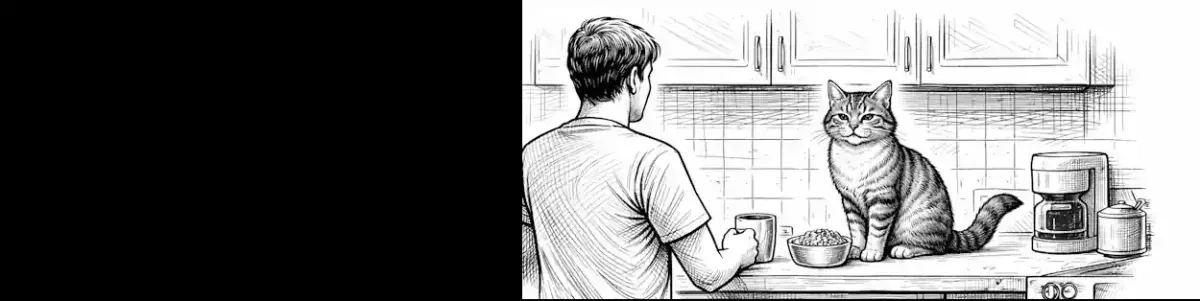
A sound completes itself behind me before I recognize it as relevant. Not loud. Not abrupt. A contained rearrangement that suggests height rather than travel. When I turn, the cat is already on the counter. Hard to tell whether the jump was a response to my entry or whether my entry simply coincided with a moment that was already underway. I attempt to reconstruct the timing and realize I am assigning sequence to something that did not present itself as sequential. The counter had been empty. I think. Or perhaps it had only been unoccupied in a way that did not require attention. The cat sits near the middle, not obstructing anything specifically, but close enough to everything to make neutrality impossible. I register this as a change in status rather than position. The counter is still a counter. It has simply become conditional. I stop moving because the next action would require deciding how much of the surface is available to me, and that decision does not resolve itself quickly enough to support motion.
The light comes on after a first attempt. The refrigerator adjusts its sound in a way that suggests acknowledgment rather than response. These actions feel procedural, like boxes being checked by a system that does not require explanation. The cat remains where it is. The mug I usually reach for is still reachable, though the reach now includes a margin I hadn’t accounted for earlier. I consider whether to take a different mug, then notice that this would still involve the same surface, just at a different angle.
The cat does not move. It does not need to. Its presence on the counter accomplishes enough without further adjustment. I stand there longer than required to confirm this, waiting for some indication that the situation will declare itself simpler if I give it time. Nothing does. Hard to tell whether that is because the situation is stable or because I am asking the wrong question.
I reach for the cabinet above the counter and stop partway through the motion, my hand hovering in a position that suggests interruption rather than hesitation. The cat’s tail is closer to the hinge than I expected. Or perhaps I expected it to be somewhere else. Hard to tell. The cabinet will open if I adjust the angle. The adjustment is minor. It still feels like a negotiation.
I think about proceeding anyway, which is a thought that takes longer than the action it is meant to authorize. During that time, the cat remains still. The counter does not change. The coffee machine continues to wait in a way that does not register as patience so much as indifference. I consider whether the cat knows what comes next and then discard the idea as soon as it forms. Knowing is too strong. Expecting is not much better. Habit seems safer, though even that assumes memory doing more work than I can verify. I notice I am monitoring the cat’s weight distribution, the way it settles more fully onto the surface, as if confirming that this position is sufficient. I interpret this as finality and then revise it. Finality implies a decision. The cat has made no visible decision. It is simply there, and the longer it stays, the more the counter feels like a place where things wait rather than happen. The thought that I could abandon the kitchen entirely crosses my mind and lingers, not because it is attractive, but because it is clean. No counter. No surface. No elevation to account for. The thought dissolves when I realize I am still standing here, my hand still lifted, committed enough to make leaving feel like an extra step.
The bowl comes down from the shelf without ceremony.
I set the bowl on the counter at a distance that feels respectful without being precise. The cat looks at it, or in the direction that includes it. Hard to tell what qualifies as looking in this context. I wait for some indication that this placement is acceptable and receive none. The absence does not read as refusal. It reads as neutrality, which is harder to work with.
There is a longer pause than the action seems to justify, during which I consider lowering the bowl to the floor and then reject the idea as unnecessary labor. The counter has already been claimed. Moving the problem vertically feels redundant. I reach for the food container instead, which is heavier than I remember and takes a moment to open in a way that does not sound like insistence. While I pour, I think briefly about whether this is the point where the pattern becomes visible, then revise the thought. Patterns require distance. This feels closer than that. The cat begins eating before I finish straightening the container. The sound is immediate, efficient. I wait long enough to confirm that eating is underway, though I’m not sure what would happen if I didn’t.
Only after this do I remember the original reason for coming in. The kettle is still empty. The mug is still unused. The counter, now partially cleared by necessity rather than permission, feels less contested but not entirely free. The cat eats without urgency. I move around the remaining space carefully, as if the arrangement might revert if handled too quickly.
Later, this sequence repeats with small variations that do not improve clarity. Sometimes the cat jumps up before I reach the counter. Sometimes the sound arrives just as my hand does. Over time, I begin to slow before entering the kitchen, as if anticipating the elevation change rather than the cat itself. Objects migrate toward the edges of the counter without a decision being made. I leave space where space is usually required. The cat’s jump becomes the real beginning of the visit, even when it happens after I am already inside.
I stop noticing when this adjustment started. Hard to tell whether it counts as learning or simply accommodation. The kitchen continues to function. Coffee is made. Food appears. The counter remains provisional. I enter, I pause, the cat is there, and the rest arranges itself in the only order that seems available.
I notice that I have begun to approach the counter as if it might already be occupied. This happens before I see anything. My hand slows. My reach shortens. The adjustment precedes evidence, which makes it difficult to classify as caution. It feels more like alignment. Sometimes the cat is already there. Sometimes it arrives a moment later, the sound folding neatly into the pause I had already created. Hard to tell which version comes first. I move objects preemptively now, not out of respect, but because the middle of the counter no longer reads as neutral space. It reads as pending.
There are visits where the cat does not jump up at all. These are not easier. I find myself waiting anyway, leaving the center clear, arranging my movements around an absence that still carries shape. The counter feels provisional even when it is empty. I complete tasks with unnecessary care. Coffee happens. Food happens. Nothing confirms that this caution was required, and nothing contradicts it either. The cat eventually appears somewhere else, or not at all. The visit ends without clarifying whether the sequence was suspended or simply delayed.
One evening I enter the kitchen and the cat is already on the counter. There is no sound this time, or else I miss it. The counter has been claimed without ceremony. I stop. The rest follows in the order it has settled into over time. Bowl. Food. Waiting long enough to confirm that waiting is no longer necessary. I move through the remaining space without correcting anything. When I leave, I don’t register the moment as complete. I just find myself somewhere else, the kitchen quiet behind me, the counter still holding whatever authority it had when I entered.