The dock did not attempt to sway, which I appreciated. Wood that remains where it is placed earns a measure of respect. A cart waited nearby, drawn by a horse whose expression suggested it had seen more plans than results. I jumped from dock to wagon with the same practical indifference that had governed my earlier appointment at sea. No speeches were delivered. I prefer it that way. The man nodded and drove. The matter was settled
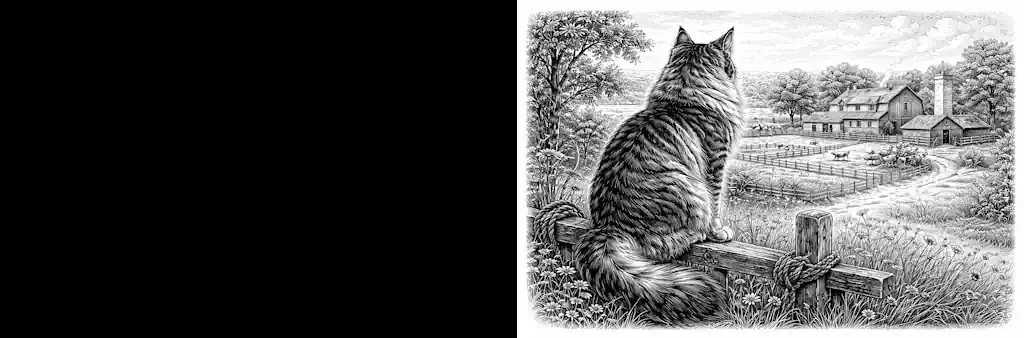
The farm revealed itself in layers rather than spectacle. A white house with windows set in symmetrical patience. A red barn whose paint had surrendered in places, exposing boards that did not apologize for age. Fences drawn across fields like careful signatures. Smoke lifting from a chimney in a thin, disciplined column. Nothing lurched. Nothing negotiated.
This is promising.
The man who drove the cart possessed hands accustomed to weight. He did not attempt introduction beyond a brief inspection of my size and a nod that implied utility. A woman stood in the doorway of the house, arms folded against the air. She regarded me with the look of someone evaluating both nuisance and necessity. I returned the courtesy.
The barn interior smelled of hay, iron, and accumulated seasons. Light entered through narrow seams between boards, descending in visible shafts that turned dust into drifting constellations. The beams overhead formed a high grid of timber and shadow, a structure more honest than the ship’s ribcage. Here, gravity was consistent.
I walked the perimeter first.
Stalls lined one wall. A ladder leaned toward the loft in an attitude of suggestion. Grain bins stood along the far side, their edges bearing the subtle scoring of teeth. I paused beside one and listened. Scratching. Brief. Cautious.
The rodents here are not political. They are practical.
Above, the loft offered elevation and insulation. Hay bales were stacked in orderly blocks, though the order showed signs of interpretation. I ascended the ladder without haste and surveyed the floor below. From this vantage, I could see the large doors, the wagon path, the threshold where cold would eventually press.
The wind moved differently here than at sea. It did not strike; it inspected. It passed through cracks and tested hinges with quiet insistence. The barn responded with low murmurs rather than groans. Wood accustomed to winter does not dramatize.
Outside, fields stretched toward a treeline dark with pine. The grass had begun to dull at the edges, color retreating inward. Leaves along the fence had adopted a brittle posture. Change was not announced. It was underway.
The farmer entered the barn carrying a sack of feed. He set it down and glanced up at me in the loft.
“Big fellow,” he said, as if identifying a structural feature.
He believes he has acquired assistance.
I descended, circled the grain bin once more, and marked the threshold of the large door with measured intent. Territory requires acknowledgment. The farmer watched but did not interfere. This was wise.
The house stands firm. The barn holds heat. The fields remain exposed but negotiable.
The sea required endurance. This place requires oversight.
The arrangement has potential.
Autumn did not arrive with argument. It adjusted the terms.
The fields, which had greeted my inspection with late-summer composure, began to thin at the edges. Green withdrew from the grass in deliberate stages, leaving behind a palette more honest and less forgiving. Cornstalks stood in rows like disciplined soldiers who had forgotten their purpose. The air acquired a sharper profile. It moved across the barn doors with intent rather than curiosity.
The farmer responded with industry.
Wood appeared in stacks along the side of the house, each log placed with the seriousness of a man attempting to negotiate with the future. He split more than necessary, then stood back to admire the geometry of his precaution. The woman inspected windows for drafts and spoke of weather reports as if the sky were a clerk who might be persuaded with paperwork.
They are reacting to a calendar.
The rodents are reacting to temperature.
There is a difference.
In the barn, activity increased in subtle but measurable increments. The scratching near the grain bins grew less cautious. Field mice, lean and restless, began exploring the lower edges of the hay stacks. Their movements were not political; they were urgent. Urgency sharpens instinct. I found this preferable to the bureaucratic complacency of shipboard rats.
One evening, I followed a narrow disturbance in the straw to its source and encountered a small delegation beneath a wooden pallet. They froze upon recognition. Their calculations were quick but incomplete.
The arrangement changes.
The farmer praised my efficiency in tones reserved for machinery. He does not understand that this is not assistance. It is jurisdiction.
Outside, the trees along the fence shed their leaves in quiet resignation. The ground grew visible in places it had not been before. The farm, stripped of excess color, revealed its underlying structure, posts, beams, furrows, lines drawn against weather rather than for decoration.
The wind began testing the large barn doors more frequently. Hinges complained. The loft retained warmth in pockets, especially near the southern wall where sunlight lingered before retreating earlier each day. I adjusted my routes accordingly.
Warmth migrates. One must migrate with it.
The woman placed a shallow dish of milk near the barn entrance one afternoon. It was unnecessary but not unwelcome. I did not approach it immediately. Ritual must be established on my terms.
By dusk, the fields carried a different sound. Less insect chatter. More hollow space between gusts of wind. The air held the faint metallic suggestion of frost not yet visible. The horse in the paddock exhaled in visible plumes during the early hours, surprised by its own breath.
The farmer noticed this and spoke of coming cold.
He believes preparation ensures outcome.
Preparation reduces inconvenience. It does not negotiate with winter.
I climbed to the loft beam and observed the yard at sunset. The sky thinned to pale amber before surrendering to a deeper blue. The barn boards contracted slightly as the temperature dropped, producing small, precise reports like distant knuckles against wood.
The policy has shifted.
Autumn is no longer transitional. It is directive.
I remain positioned.
Winter is approaching.
The first frost did not request permission.
It arrived during the hours when even the barn holds its breath. By morning the water trough bore a thin, crystalline argument across its surface. The horse regarded it with confusion before shattering it with a deliberate strike of hoof. The sound carried cleanly across the yard.
The audit has begun.
The fields, once merely thinning, were now exposed. Grass lay flat and silvered. The fence posts cast longer shadows, sharper at the edges. Breath became visible, mine, the horse’s, the farmer’s. As if the air required proof of occupation.
Inside the barn, the temperature tightened.
Wood contracted. Metal stiffened. The grain bins emitted faint ticks as the cold settled into their joints. The mice had grown bolder in autumn; now they had grown desperate. I found them navigating higher beams and deeper corners, seeking insulation in places not designed for tenants.
Desperation simplifies hierarchy.
I adjusted my routes.
The loft retained warmth longest, especially where hay had been freshly stacked. Beneath the south-facing boards, sunlight lingered in diluted form. I marked these coordinates carefully. Warmth is not sentimental. It is strategic.
The farmer entered earlier each morning, boots striking the frozen ground with unnecessary authority. He carried additional bedding for the horse and muttered about the forecast as if the sky were misbehaving. The woman sealed small drafts around the kitchen door and placed heavier curtains along the windows.
They believe barriers are sufficient.
Barriers are temporary. Positioning endures.
Snow threatened twice before committing. The clouds lowered, considered, and passed on, leaving only a thin crust along the fence rails. I watched from the barn doorway as wind carried dry leaves into corners where they would remain until buried. The landscape had shed its excess. What remained was structure.
The farm has narrowed.
Paths that were once broad are now defined by resistance. Footprints reveal intention. Tracks in frost record every miscalculation. Even the mice betray themselves with delicate inscriptions along the barn wall.
The farmer praised my vigilance again after discovering reduced gnawing in the feed sacks. He does not understand that vigilance is not effort. It is alignment.
At dusk, I walked the fence line and examined the treeline beyond. The pines remained green, indifferent to frost. They stood as they had stood when I first arrived, accepting cold as a recurring guest rather than a catastrophe.
The sea demanded endurance. This land demands constancy.
The first true snow will come soon. I will already be positioned.
The review continues.
Snow committed in earnest the following week.
It did not drift tentatively across the fields. It settled with quiet authority and remained. Fence posts shortened. Paths vanished. The barn doors acquired white shoulders. The world simplified itself to contrast of dark timber, pale ground, moving figures.
Sound changed first.
Footsteps no longer struck; they compressed. The wind did not rustle; it skimmed. Even the horse reduced its commentary to low, visible breaths that dissolved into the air like reluctant signatures.
The farm had entered its most honest configuration.
From the loft beam I surveyed my jurisdiction. Tracks mapped the yard in clean hieroglyphs, a farmer to barn, barn to woodpile, woodpile to house. My own lines intersected theirs with deliberate economy. The mice had retreated deeper into insulation and caution. Their urgency had been replaced by calculation.
Winter rewards those who remain.
The farmer called me “good cat” more frequently now, as if the repetition solidified the fact. He does not understand that goodness is a human category. I am efficient. That is sufficient.
One afternoon, as the light thinned early and the sky adopted the dull sheen of brushed steel, I detected a new scent at the perimeter of the barn. Not rodent. Not horse. Not human.
Feline.
I descended without haste.
Near the woodpile, where snow had drifted against the barn wall, she stood, large, smoke-grey, her ruff thick against the cold, ears tipped like careful antennae. She regarded the barn, then me, without deference and without fear. Her breath appeared in steady intervals.
She has survived this long.
That is not accidental.
The wind pressed against her fur and failed to rearrange it. She stepped forward once, testing the packed snow near the doorway. I remained still, offering no challenge and no invitation. Territory must be acknowledged before it is shared.
We regarded one another across the threshold of the barn, the snow between us unmarked by conflict.
The farmer noticed her from the porch and called out in mild surprise, as if winter had delivered a parcel. He approached slowly, hands visible, voice softened into persuasion. She did not retreat. She adjusted her angle and observed him as she had observed the barn, measuring his structure, not tone.
This arrangement has possibility.
By nightfall she had entered the barn, selecting a position opposite my loft beam, neither subordinate nor confrontational. The mice, sensing new variables, recalculated in silence.
The barn held two points of heat now.
Outside, snow continued its quiet governance. The fields lay white and unarguable. The house glowed faintly from within. The farmer and his wife spoke in low voices about fortune and timing and what to call her.
Names will be discussed. Names are secondary.
She moved with deliberation. She met my gaze once more and did not look away.
Winter had reduced the farm to essentials, wood, breath, persistence.
Now there were two.
The sea tested endurance.
Winter tested constancy.
This land will test lineage.
The dynasty begins.