The “I Know What I’m Doing” Illusion
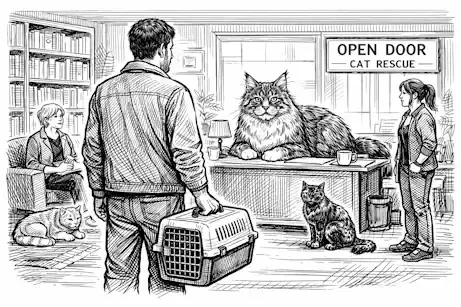
I brought Laura home from the rescue with the quiet confidence of a man who’d done his research. Which is to say, I’d watched a lot of cat videos. I had the basics: a litter box, a bag of kibble the shelter gave me, one of those carpeted cat trees that looked sturdy in the online photo. I was prepared for a cat. A normal cat.
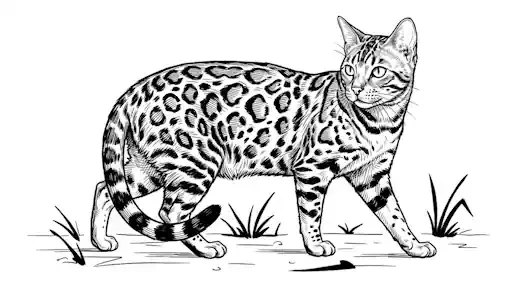
Laura, a nine-month-old Bengal with eyes like polished copper, surveyed her new kingdom, my seven-hundred-square-foot apartment, from the carrier doorway. She did not meow. She issued a low, thoughtful chirp. Then she flowed out, a liquid chain of muscle and spotted fur, and went directly to the tallest bookcase. She did not climb it. She ascended. It was a vertical annexation.
By hour three, the cat tree was a derelict monument. She’d scaled the curtains to the rod.
The kibble was sniffed and then ignored with a look of profound betrayal. My phone, left charging on the side table, was batted to the floor and systematically pushed under the couch. This wasn’t aloofness. This was a full-scale systems audit.
I learned that first week that everything I thought I knew about cats applied to other cats. The ones that napped. The ones that considered a cardboard box peak entertainment.
Laura’s energy wasn’t a trait; it was a natural resource. She didn’t play. She executed tactical operations. The midnight sprint across my chest wasn’t a zoomie; it was a perimeter check.
The litter box was acceptable, but the water in my glass was clearly superior. She’d dip her paw, stare at the ripples, then look at me as if to say the management of liquids in this territory was now her portfolio.
I’d brought home a small, spotted sovereign. I had furnished a studio apartment. She had expected a jungle gym. Hard to tell who was more surprised. Probably both. Probably always.
The Vertical Learning Curve
I discovered the first new perch on a Tuesday. I was making coffee, turned around, and there she was, a living statue on top of the kitchen cabinets, her tail a slow metronome against the ceiling. She hadn’t jumped from the counter. She’d used the refrigerator as a stepping stone, a move I hadn’t even considered possible. The look she gave me wasn’t pride. It was a simple statement of fact: this is now a thing I do.
The bathroom door frame came next. I walked in and found her balanced on the three-inch-wide molding, a tightrope walker surveying the porcelain kingdom below. Her acquisition of vertical real estate was relentless. She wasn’t seeking a vantage point. She was conducting a survey, mapping the airspace.
The shower curtain rod was the masterpiece. I still don’t know the physics of it. I came home to find her curled in the hollow of the plastic curtain, a hammock strung over the tub, swaying gently. She opened one eye, saw it was just me, and went back to sleep. The rod hadn’t broken. It had merely accepted its new function.
Cat-proofing a small apartment, I learned, is a fool’s errand. You don’t secure the high ground. You just learn to share it. You move the breakables, sure. But the real shift is mental. You stop seeing a bookshelf as a bookshelf. You see it as a potential launchpad. That six-foot cat tree in the corner, the one with the plush beds and dangling toys? It’s a diplomatic gift. A suggestion. She uses it, sometimes, as a waystation between more interesting conquests.
We observe, we wonder, and we accept. The treaty is simple: I provide the kibble and the occasional chin scratch. She refrains from knocking the television off its stand. Everything above waist height is hers by divine right. It’s a workable arrangement.
The Apartment Olympics
The theory of cat ownership, as I understood it, involved a soft creature in a sunbeam. A gentle purr. A slow blink.
Laura’s theory involves velocity.
Seven hundred square feet is not a home to her. It’s a kinetic equation. A parkour gym with poor lighting and a suspiciously stationary human component. She doesn’t walk. She calculates trajectories. The sofa isn’t for sitting; it’s a primary launch vector. She hits it at a dead sprint, coils, and becomes a spotted projectile aimed at the bookshelf. The thump is a punctuation mark in a sentence I’m still learning to read.
Three a.m. is her preferred training window. The world is quiet, the shadows are long, and the track is clear. I lie in the dark and listen to the symphony. The skitter of claws on hardwood. The heavier thud of a landing that has just a little too much enthusiasm behind it. A silent pause, which is somehow more alarming than the noise. Then the ricochet off the far wall. She uses doorframes like springboards. Hard to tell if she’s chasing ghosts or just auditing the structural integrity of my drywall.
I learn the first law of Bengal thermodynamics: energy cannot be destroyed, only transferred. And it transfers directly into my central nervous system.
The solution, whispered in online forums by people with the same shell-shocked look in their profile pictures, is exhaustion. A tired Bengal is a sane Bengal. Sanity being a relative term.
So, the living room annexes a new piece of furniture. A large, black, hamster-style wheel. It looks like modern art, or a very quiet torture device.
Laura approaches it with the caution of a bomb disposal expert. She sniffs. She taps it with a paw. It moves. Her entire body language shifts from suspicion to predatory calculus. This is not a toy. This is a challenge to her sovereignty over motion itself.
She steps on. The wheel turns. Her walk becomes a trot, then a sprint. The whirring sound fills the apartment. She’s running nowhere, perfectly, a contained cyclone of spotted fur.
We observe, we wonder, and we accept.
She runs for ten minutes, then hops off, perfectly composed. She gives me a look that is neither gratitude nor apology. It’s a report. Energy levels: managed. Territory: secured. Human: marginally useful.
She then walks, calmly, to the sofa and goes to sleep.
The apartment is quiet. For now.
Helping” with Chores (A Definitional Crisis)
I learn that Laura has a very specific definition of “helping.”
It’s not a passive concept. It’s not about moral support or quiet companionship. For a Bengal, helping is a full-contact, kinetic insertion of self into the middle of whatever you are doing. It’s a territorial claim on the activity itself.
Take making the bed.
For me, it’s a simple, two-part process: straighten the sheet, pull up the duvet. A thirty-second administrative task for the kingdom of sleep.
For Laura, it’s the opening of a wrestling arena. The moment the sheet lifts, a blur of spotted fur rockets into the newly created cave beneath. The flat plane becomes a heaving, shifting landscape. I see a paw dart out to snag a corner I’m trying to smooth. I tug. The sheet tugs back, possessed by a determined, unseen force. I am no longer making a bed. I am engaged in a negotiation with a subterranean sovereign over the terms of linen placement.
If I win, and manage to get the duvet on top, the game simply evolves. Now the goal is to burrow from the side, to create a lump in the middle, to become the living, breathing lump that ruins the clean lines. Victory, for her, is becoming an immutable part of the structure.
Folding laundry is worse.
A sorted pile of warm t-shirts is not a chore to be completed. It is a fortress to be besieged. She doesn’t knock it over for the chaos. That’s amateur stuff. She surgically removes one sock from the center of the pile, leaving the rest perfectly intact. She carries it a short distance, drops it, and stares at me.
This is not theft. It’s an invitation. She has captured the sock. The game is now “reclaim the sock.” If I move toward it, she pounces, pins it, bats it further away. The act of folding cannot proceed until the hostage negotiation is resolved. The laundry remains half-folded, a monument to her successful insertion into the workflow.
Working from home required a complete paradigm shift.
I used to think a keyboard was for typing. I was wrong. A keyboard, to a Bengal, is a personal, heated lounging pad that happens to make interesting clicky sounds when you lie on it. My hands, attempting to type, become an annoying massage feature. She will settle directly on the keyboard, her body spanning the spacebar and the delete key, and purr as I try to peer around her to see the screen.
Trying to move her is an exercise in futility. She becomes liquid and heavy, a purring weight of absolute entitlement. The meeting is happening, and she is the main participant. My job is to provide the warm lap and the clicking noises.
I begin to understand. She isn’t trying to stop me. She’s not being malicious. From her perspective, any activity I am doing alone is an activity being done incorrectly. My solo efforts are a sad, silent movie. Her role is to provide the special effects, the plot twists, the living, breathing set dressing.
Hard to tell if it’s a desire for partnership or a simple refusal to be left out.
Probably both. Probably always.
So we develop a new routine. I make the bed with one hand while defending the sheet with the other. I fold three shirts, then play one round of sock hockey. I type emails with a warm, spotted body draped over my wrists, her purr vibrating through the keys.
We observe, we wonder, and we accept. I am not doing chores anymore. I am conducting them with a small, furry, and immensely serious co-pilot. The work takes twice as long and accomplishes half as much.
But it’s never boring.
The Water Conspiracy
I always knew cats had a thing for water, but Laura’s relationship with it isn’t a thing. It’s a full-blown, multi-department bureaucratic initiative.
It started with the toilet. Not drinking from it, thank god, but the flush. She’d appear from nowhere, a silent spotted missile, to perch on the tank and watch the vortex with the solemn intensity of a physicist observing a quantum event. Her head would tilt, ears forward, every muscle coiled in rapt attention. I’d finish my business, she’d supervise the ceremonial whirlpool. It was her favorite show.
Then came the cabinet.
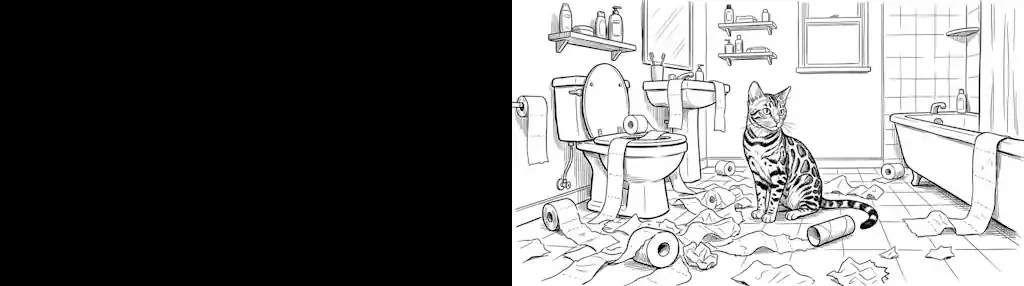
My bathroom is small. There’s no spare room, no hidden nooks. The under-sink cabinet has those cheap magnetic child-locks, the kind that go click. I found out they don’t work on determined Bengals. I came home to a scene of damp anarchy. The cabinet door was swung wide. A single, ravaged roll of toilet paper had been extracted, unspooled into a sodden, shredded mound in the middle of the floor, which was itself covered in a fine sheen of water. She’d clearly fished it out, batted it into the toilet bowl for a good soak, then performed her extraction and deconstruction ritual. She sat beside the wreckage, one paw resting on a clump of pulp, looking not guilty but profoundly satisfied, like a foreman after a productive shift.
The water bowl was an insult to her. A stagnant, still-life puddle? Unacceptable. She’d sit beside it and give me a look that said, You expect me to drink from this? It’s not even moving. I got a fountain. One of those ceramic ones with a little pump that makes a gentle burble. She approved of the principle but not the execution.
Her drinking ritual is a three-act play. First, she approaches with deliberate slowness, as if assessing the flow rate for irregularities. Then, she extends a single paw—not to drink, but to dab at the stream, splashing a considerable amount onto the floor around the base. Only after this quality-assurance test does she deign to lower her head and take a few delicate laps. The result is a permanent moat. I have a specific towel for the fountain zone now. It’s always damp.
She’s discovered the sink, too. If I’m brushing my teeth, she’s on the counter in a flash, patting at the dribble from the faucet. If I run a bath, she’s perched on the edge, tail twitching, debating the aerodynamic properties of a rubber duck. She doesn’t want to get in. She just wants to oversee the hydrology.
I bought a mop for the first time in my adult life. A real one, with a spin-bucket. I use it more than I use my vacuum. The floor by her fountain, the trail from the bathroom, the occasional mysterious puddle by the front door that I think might be condensation from her planning sessions. Hard to tell.
I was wiping up the latest splash zone this morning, the mop making its familiar swish-swish on the linoleum, when it hit me. I used to clean this apartment maybe once a week. A quick pass with a sweeper. Now, I’m performing daily damp patrols. I have a towel rotation. I’m auditing toilet paper inventory.
I looked over at her. She was sitting in a square of sun, meticulously licking a paw, then smoothing it over her ear. Every move efficient, dry, perfect.
We observe, we wonder, and we accept.
I now mop more than I ever did.
When Silence Is Suspicious
The silence is the first clue. It’s not a peaceful quiet, not a resting quiet. It’s the quiet of a vacuum, of a system holding its breath. A silent Bengal is a Bengal up to something. This is the mental game, the real learning curve. You don’t own a force of nature; you audit its operations, you try to predict its next vector. And you fail, often.
My first learning moment arrived after welcome silence with a soft, plastic thump from the kitchen, followed by the distinct, slow grind of a seal breaking. Not a crash, not a bang. A methodical sound. I found her there, a spotted sovereign sitting proudly before the open bottom freezer drawer of the fridge. The door swung wide, a cold mist curling around her like royal incense. She wasn’t trying to get in. She’d already won. She’d been studying the leverage, the weak point in the seal, the precise angle of paw application. The victory was the point. The frozen peas were just the spoils.
Another lesson came on a Tuesday. The apartment was too still, the kind of stillness that rings in your ears. I’d been working, lulled by the absence of parkour.
A mistake. I found the evidence under the bed, in the dark kingdom she’d claimed as her own. Not a single roll of paper towels had been spared. They weren’t just torn; they were systematically deconstructed, unspooled into a mountain of confetti, a shredded monument to concentrated, silent effort. She watched me from the bedroom doorway, her expression utterly serene. It wasn’t destruction for its own sake. It was a project. A statement. See what I can do when you’re not looking?
No more twelve pack Paper Towels stored in the bedroom. Hard to tell, it's a small apartment.
You start to read the quality of the quiet. The pensive quiet means she’s plotting a jump from the bookshelf to the top of the door frame. The investigative quiet means she’s discovered a new seam in the sofa cushion and is determining how many claws are required to breach it.
The achievement quiet, the most dangerous one, is always followed by the discovery of a new skill. Like the morning I walked into the bathroom to find the faucet in the sink trickling steadily, and her, perched on the edge, one damp paw resting on the cold tap as if she’d just concluded a delicate negotiation with the plumbing.
Hard to tell if it’s genius or entropy. Probably both. Probably always.
The game isn’t about stopping her. That’s a fool’s errand, a bureaucratic overreach. The game is about anticipation. It’s about learning her operational patterns, her cycles of kinetic research. You become a warden of a tiny, chaotic principality. You observe the clues, the new scuff mark on the wall, the suspiciously clean patch on a high shelf, the specific drawer left slightly ajar. You piece together the silent report.
We observe, we wonder, and we accept. The silence is never empty. It’s just waiting for me to catch up.
The Turning Point: Why It’s Worth It
I’m not sure when the ledger flipped from deficit to surplus. It wasn’t a single moment, more like a slow, dawning realization that the exhaustion had a purpose, and that purpose was currently chirping at me from the doormat.
She’s there every evening now. Not just in the apartment, but at the door, her whole body a question mark of a tail, her chirp a sound that exists somewhere between a bird and a greeting. It’s not a needy sound. It’s a statement of fact: you just got home, I am here, the evening’s operations may now commence. She’s not waiting for food. She’s taking attendance.
The operations have evolved. I threw a crinkly ball of foil one night, a gesture of pure fatigue. She streaked after it, a bolt of spotted lightning, snatched it, and trotted back. She dropped it at my feet and looked up, her eyes two green moons of expectation. I threw it again. She brought it back. We did this seventeen times.
Do I have both a dog and cat, now, I thought, or a cat that can open cabinet doors and judge my water glass selection? Hard to tell.
Later, when the last of my energy has been converted into thrown toys and redirected leaps, she does the other thing. She finds me on the couch. She doesn’t ask. She simply ascends, turns a precise circle on the cushion beside my hip, and settles into a compact loaf, her side pressed against my leg.
Her purr is a deep, industrial hum that vibrates up through the bones of the house. This is not a request for affection. It is a treaty. The day’s campaigns are over. The territory is secure. We observe, we wonder, and we accept.
I was not ready for a Bengal. I know that now. I was ready for a pet, a quiet companion, a piece of living furniture. What I got was a kinetic partner, a tiny, furry auditor who forced me to upgrade my entire system.
A beginner cat would have let me be lazy. Laura made me creative, engaged, perpetually on my toes. She turned my apartment into a gym and my routines into a game. I am more tired than I have ever been, and more awake.
Probably both. Probably always.
A Sane Person’s Living With A Bengal Cat Checklist, Somebody Else, Not Me
So, Should I have done it? I’m not the person to ask. I’m the one who brought a small, spotted hurricane into a one-bedroom apartment and called it a good idea.
But if you’re thinking about it, here’s the checklist I wish someone had slid under my door. It’s not from an expert. It’s from the trenches.
First, time. Can you dedicate one to two hours of active, engaged playtime every single day? Not just waving a feather wand while you watch TV. I mean full-on sprints, leaps, chases. Think of it as a daily gym membership for a client who never cancels.
Second, your stuff. Are you okay with never owning nice curtains? Or a sofa without claw marks? Do you understand that every horizontal surface is a potential launchpad, and every vertical one is a climbing challenge? Cat-proofing is a myth. You’re just negotiating surrender terms.
Third, the budget. A cat wheel isn’t a luxury. It’s a necessity, like a treadmill for a caged tiger. Sturdy wall shelves aren’t decor. They’re infrastructure. A water fountain isn’t a cute accessory. It’s the only way to prevent a bathroom flood every time she decides to investigate hydrodynamics.
Can you read silences? The quiet doesn’t mean she’s sleeping. It means she’s planning.
Do you want a pet, or a co-pilot? One that rewrites your routines, turns chores into collaborative missions, and considers your keyboard her personal heating pad?
A Bengal isn’t a beginner cat. She’s a lifestyle audit. She’s kinetic energy with fur and opinions.
For the right person, or the right kind of crazy, it’s an adventure. The kind that leaves you exhausted, covered in water, and weirdly, completely awake for the first time.
Hard to tell if you’re that person.
Probably best to assume you’re not. Probably I'm not either.