The Drive to the Open Door Cat Rescue
I wake before the alarm, which is not unusual. What is unusual is the stillness that follows, a moment where I lie there waiting for the usual inventory of aches and regrets to present themselves, and they do not. The ceiling is the same ceiling, the light is the same grey that pushes through the blinds, but something has shifted. Today I get my cat. The thought is not a thought so much as a fact that has taken up residence in my chest, a small dense weight that makes breathing feel different.
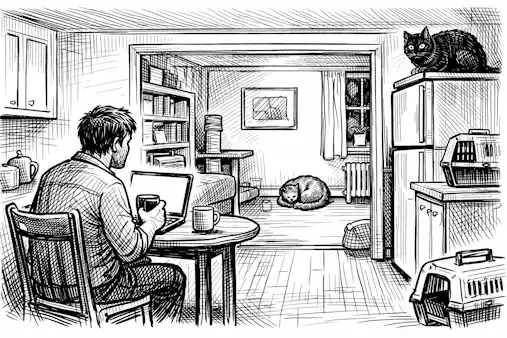
I dress without looking in the mirror. Jeans that fit, a sweater that has been folded on the chair for three days, shoes I do not have to tie because I learned that lesson years ago. The carrier is by the door, a blue plastic crate with a metal door that rattles when I pick it up. I borrowed it from the woman downstairs, the one with the Siamese that yowls at the mail slot. She asked me if I was sure, if I knew what I was getting into, and I said yes because that is what you say when you have been alone long enough to mistake certainty for courage.
I do not eat breakfast. I do not make coffee. I have been told there will be coffee there, at this place, this rescue with its painted cat in the window and its door that is always open, or so the website says. The website said a lot of things. I read it four times last night, memorizing the address, the hours, the photograph of the grey cat in the laundry basket with his ears like antennae and his eyes the color of pennies left too long in a drawer. I tell myself I am going to look, to see, to let the universe do its work. The lie sits next to me on the passenger seat, the carrier and neither of us believes it's and empty effort.
I take the stairs down. The hallway smells like the cooking oil from the apartment at the end, the one where the woman fries everything at seven in the morning. I pass her door and I hear the television, some morning show with its bright manufactured laughter, and I think about how long it has been since I had a reason to make noise before eight oclock.
The morning air hits me when I step outside. It is cold in that way that will make the car feel like a refrigerator you are forced to sit inside. I unlock the door, set the carrier on the passenger seat, and I buckle it in. The seatbelt clicks across the plastic. I stand there for a moment with the door open, watching my breath fog the glass, before I walk around and get behind the wheel.
The engine turns over on the second try. I pull out of the lot and the city is waking now, the streets filling with the morning traffic that moves with the particular rhythm of people who have places to be they did not choose. I merge onto the main road, the one that cuts through the strip malls and the gas stations and the apartment complexes with names like The Willows where no willows grow. The light at the intersection takes forever, then cycles through three cars before turning red again. I wait.
The radio is off. I drove this route yesterday to be sure, to time it, to remove the variables that might become excuses. Twenty-two minutes if the traffic is light. Thirty if it is not. I know the turn, the left at the shopping center with the CVS, the right onto the street that runs behind the library. I have looked at the street view on the laptop enough times that the buildings no longer feel unfamiliar. I could walk this route with my eyes closed, which is a strange thing to know about a place you have never noticed.
I think about the carrier buckled into the seat beside me. I think about the woman downstairs and her Siamese and the way she said "are you sure" like she was asking about something permanent, something you cannot return when the novelty wears off. I am sure. I am not sure. I am a man driving toward a painted cat in a window with a plastic crate in the passenger seat and a set of copper eyes that I have only seen through a computer screen.
The traffic thins as I move away from the commercial strip. The buildings become smaller, older, the ones with awnings that need replacing and signs that have been there long enough to fade. A bakery with its lights on. A barber shop with the striped pole turning slow. A bookstore that looks like it has not had a customer in years. I am in the main street now, the one that belongs to the town that exists inside the suburb, the part that was here before the strip malls and the apartment complexes with their fake names.
My Arrival At The Cat Rescue
I see the painted cat.
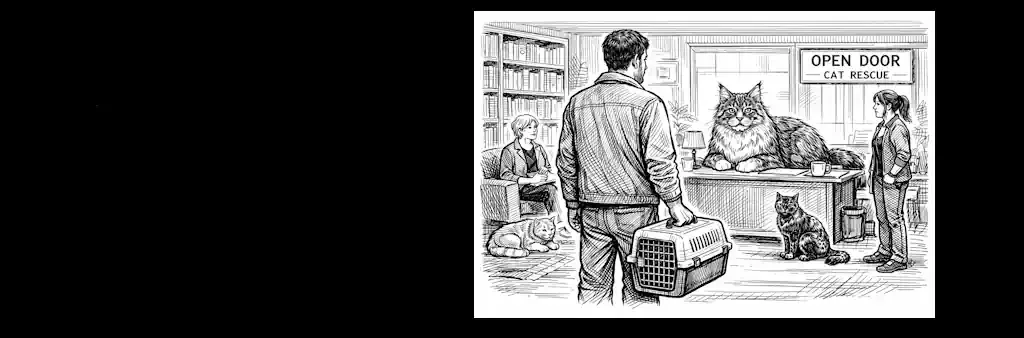
It is in the window of a storefront that was probably a shoe repair once, or a insurance office, some other business that gave way to something stranger. The sign above the door says Open Door Cat Rescue in a font that is trying to be charming and landing somewhere else. There is a light on inside. I can see it through the glass, a warm yellow that spills onto the sidewalk, and I pull into the space across the street because I need a moment, because I need to sit here with my hands on the wheel and remind myself how to breathe.
The carrier rattles when I turn off the engine. I look at it, this blue plastic thing that is about to become the container for something I have been avoiding for years, and I realize I have not thought about what happens after. I have thought about the drive, about the rescue, about the Maine Coon Cat with the copper eyes. I have not thought about the silence that follows, the way a twenty-pound fact will change the physics of my apartment, the way a heartbeat that is not mine will occupy the space I have been saving for no one.
Probably a trip already years not starting. Hard to tell.
I get out of the car. The cold hits my face and I reach back in for the carrier, unbuckling the seatbelt with a pull that feels more permanent than it should. The plastic handles are cold against my palm. I cross the street, the crate swinging at my side, and I am at the door before I have decided to open it. The bell chimes. The warm air hits me. I am inside.
There is a lobby, small and warm, and then another door. A second door, this one with a window, and beyond it I can see movement, shapes that are too low to the ground to be people. The carrier feels heavier now. I set it down on the floor next to my feet and I am standing between two doors, the one I came through and the one I have not yet opened, and I realize I have been holding my breath since I crossed the street.
I open the second door. I pick up the carrier. I step through.
The Room And The Rescue
I am standing in a room that should not feel like a threshold but does.
The second door closes behind me and the lobby disappears, the street disappears, the car disappears, and I am here, wherever here is. The space opens up in a way the lobby did not. High ceilings, wide floors, the kind of square footage that used to sell furniture or fabric or something that required room to spread out. Now it is arranged in islands. A couch here, a cluster of armchairs there, a low table pushed against a wall with a reading lamp that casts a warm circle of light on nothing. The floor is scratched in places. The baseboards show the wear of small bodies moving along them.
There are no cages.
I look for them because I expected them, because every shelter I have seen on the screen had rows of metal doors with labels and laminated cards. But there are none. The cats are everywhere. Draped over the back of a chair like a fur stole someone forgot to put away. Curled on a window seat where the morning light has pooled. Tucked into a cardboard box that has been set on its side with a blanket folded inside. One is on the floor near my feet, a tortoiseshell with a torn ear, and she does not move when I step forward. She looks at me, blinks once, and closes her eyes again.
It is not chaos. There is a logic to the arrangement, a geography I do not understand yet but can feel. The cats have territories. Agreements. Lines drawn in ways that do not require fences. A large orange tabby occupies the armchair by the window and the others do not approach. A calico has claimed the top of a bookshelf and watches everything with the patience of a creature who has solved the problem of being small. They move around each other with a precision that looks like indifference but is something else. A society. A parliament. A long negotiation that has reached a truce none of them bothered to explain to me.
I am standing just inside the door. The carrier is in my hand, and I have not set it down because I do not know where to put it, because I do not know the rules for entering a space where I am the guest and they are the residents. The tortoiseshell by my foot opens one eye, decides I am not interesting, and goes back to her sleep. The orange tabby watches me with the flat expression of a landlord who has seen too many applicants.
I stand there holding an empty crate, waiting for a parliament to decide if I am allowed to sit down.
Hard to tell.
Marie
I do not see her at first. That is the point of her, I realize later. She is the kind of person who lets the room speak before she does.
She comes from somewhere in the back, through a door I did not notice or from behind a curtain that hangs near the far wall, and she does not announce herself. There is no hello that cuts through the quiet, no bright voice to fill the space I have been occupying with my hesitation. She simply arrives, and the room adjusts. An orange tabby does not look up. The tortoiseshell does not move. But something shifts, a small recalibration, as if the gravity has been redistributed.
Marie.
I know it is Marie because the website had a photograph, a small one in the corner of the About Us page that I scrolled past twice before I actually looked at it. She is older than I expected, or maybe younger, it is hard to tell with people who have decided exactly how much of themselves to show. Her hair is grey and cut short, practical, the kind of cut that does not require thought in the morning. Her hands are at her sides. She is not holding a clipboard or a form or anything that would make this feel like a transaction.
She asks if I am here for the visit. I say yes. She asks if I filled out the pre-visit form online. I say yes and give it. She nods, once, and that is the end of the paperwork portion of our relationship.
The fee is mentioned. She says it plainly, a number, no apology, no explanation about what it covers or why it exists. I reach for my wallet and I am surprised by how relieved I am. There is something clean about it. A door that opens for a price is a door you know how to open. I hand her the card and she takes it to the desk against the wall, the one pushed to the side like it does not want to be the center of anything, and I stand there with the carrier at my feet and my hands empty and I do not know what to do with them.
I walk to the bookshelves.
They line the wall to my left, floor to ceiling, and every single one is about cats. Histories of cats. Memoirs about cats. Field guides to cat breeds with photographs so glossy they look polished. A book on cat behavior with a spine that has been cracked so many times the title is barely legible. I pull one out without looking at the cover, just to have something in my hands, and I run my finger along the edge of the pages. The paper is smooth. The book is heavier than I expected.
Marie is at the desk, running my card through a machine that makes a small electronic sound. She does not watch me. She does not need to. I am a man holding a book about cats in a room full of books about cats and I am not going anywhere.
She hands me back the card. She asks if I would like coffee. The question is not an offer, exactly, more of a statement about how things work here. Coffee is part of the architecture. I say yes without meaning to, without having decided, and she disappears through the same door she came from, the one I did not notice, and I am alone again with the books and the carrier and the orange tabby who has not stopped watching me.
I put the book back. I run my finger along another spine, then another, not reading the titles, just feeling the friction of paper against my skin. The room is quiet. The radiator is not here to tick. The pipes are not here to clear their throats. There is only the small hum of the coffee machine from wherever Marie has gone and the weight of a building full of cats on the other side of a door I have already opened.
The door with the window. The one I stepped through to get here.
I realize I am still standing in front of the bookshelves when Marie returns with a mug. She sets it on the desk, does not hand it to me, leaves it there for me to collect when I am ready. I walk over and pick it up. The mug is warm. The coffee is dark. I hold it with both hands and I am standing in a cat rescue with an empty carrier at my feet and I have not yet seen the cat I came to see.
Hard to tell.
Jennifer
The second door opens and someone else comes through it, and I know immediately this is the other one.
She is not Marie. Where Marie is the gravity that holds things in place, this woman is the force that moves them. She comes through the door with the window, the one that leads to the room I have been pretending I haven't entered, and she does not walk so much as arrive already in motion. Her hair is longer, pulled back in a way that suggests it escaped five minutes ago and she has decided to let it. Her voice is not loud but it is quick, the words coming out in a rush that makes the quiet of the lobby feel suddenly insufficient.
"You brought a carrier," she says, and she is looking at the blue crate by my feet like it is the most interesting thing she has seen all week.
I say yes. I say I borrowed it from a neighbor. I do not know why I add that part, why I feel the need to explain that I do not already own a cat carrier, that this is not something I do every day, that I am new to the vocabulary of plastic crates and the weight of an empty thing you intend to fill.
She smiles. Her name is Jennifer, she says, though she does not say it like an introduction, more like a reminder she assumes I already know. I do know. The website had a photograph of her too, standing next to Marie in front of the painted cat in the window, and even in that small square of pixels I could see the difference between them. One holding the frame steady. One pulling it forward.
She asks which cat I came to see and the question is simple but it lands in my chest like a stone dropped into still water. I have been carrying the answer with me since I woke up, since I dressed without looking in the mirror, since I buckled the carrier into the passenger seat and drove through the morning traffic and crossed the street with a crate swinging at my side. I have been carrying it and pretending I was not.
The Maine Coon, I say. The one on the website. The one in the laundry basket.
Jennifer laughs. It is not a mean laugh, not the kind that makes you feel foolish for wanting something, but there is something in it that tells me I am not the first person to walk through this door with that particular photograph in my head. She says that is Gordon. She says he has opinions. She says he will let you know if he approves of you, and she says it like she is describing the weather, like it is a fact of the natural world and not something a man with an empty carrier should find intimidating.
She turns and walks further into the room.
I pick up the carrier. I do not set down the coffee.
I follow her, carrier in one hand, coffee in the other, stepping carefully over the tortoiseshell who has not moved from the floor and around the armchair where the orange tabby holds his territory.
I am looking for a grey cat with tufted ears.
I pick up the carrier. I do not set down the coffee. I follow her through the door.
Gordon - The Maine Coon Cat
He is not in the laundry basket.
I have been looking for the laundry basket, scanning the room for that particular shape, the one from the photograph that has been living in my head for days. But there is no laundry basket. There is a desk near the back wall, pushed against the windows where the morning light comes through in a way that turns everything soft, and on that desk there is a blotter and a stack of papers and a massive grey cat who has claimed all of it.
He is not sitting. He is occupying. There is a difference I did not know I understood until I saw it. His body is a sprawl of smoke-grey fur that seems too large for the desk, his front paws hanging over the edge, his tail draped across a folder like he is marking it as his. The tufted ears are there, the ones I have been memorizing on a screen, but they are not the neat antennae the photograph suggested. They are ragged. Imperfect. One of them has a small notch, a flag of a life that happened before pixels.
His eyes find me before I find him, I think. Or maybe they were already watching the door, waiting to see who would come through it with a carrier and coffee and the particular posture of a man who does not know where to stand. They are copper, the color of old pennies, and they do not blink.
I stop walking.
Jennifer has stopped too, a few feet ahead of me, and she is watching this with the expression of someone who has seen this particular transaction unfold many times. She does not say anything. She does not need to. The room has gone quiet in a different way now, not the ambient quiet of cats who have accepted my presence, but a focused quiet, a silence that has a direction.
Gordon watches me.
I am holding a carrier in one hand and a mug of coffee in the other and I am standing in a room full of cats and I do not know what to do with any of it. I set the coffee down on a table I did not notice I was standing next to. I set the carrier down on the floor. My hands are empty now and I do not know what to do with them either.
He does not come to me. I have read about cats who come to you, who cross a room to investigate a stranger, but Gordon is not that cat. He stays on the desk, a twenty-pound fact, and he watches me with eyes that have seen another man in another house, another set of hands, another life that ended somewhere I cannot see. He is not unfriendly. He is not friendly. He is waiting.
The silence between us is not empty. It is the silence of two creatures deciding if they can share the same physics, the same hours, the same narrow stretch of floor by a radiator. It is the silence of a parliament that has not yet taken a vote.
I do not approach him. I do not call to him. I stand where I am, hands at my sides, and I let him watch.
Hard to tell.
The Terms
I do not know how long I stand there. Long enough for the coffee on the table behind me to stop steaming. Long enough for the tortoiseshell to get up, stretch, and move to a different patch of floor. Long enough for the orange tabby to lose interest in me entirely and close his eyes.
Gordon does not close his eyes.
He is still on the desk, still watching, and I am still standing with my hands empty and my feet planted in a spot I have not moved from since I set down the carrier. I am aware of Jennifer, of the other cats moving through their morning routines, of the particular quality of light that comes through windows that face out. But mostly I am aware of the copper eyes that have not left me.
Marie appears. I did not hear her come in, did not see her cross the room, but she is beside me now, standing in the same quiet way she does everything, and she does not fill the silence. She stands with me. She lets the silence be what it is.
When she speaks, her voice is low, meant for me, not for the room. She tells me Gordon came from an estate. His owner was an older man, she says, lived alone, had Gordon since he was a kitten. The man passed in the fall. Gordon waited by the door for several days after, until the family came to clear the house.
She says it plainly. No softening. No extra weight. Just the facts of a life that ended and a cat who did not understand why the door stopped opening.
I look at Gordon. He has not moved, but something in his posture has shifted, or maybe I am just learning to read him. There is a vigilance in him that is not fear. It is the vigilance of a creature who has learned that doors close and people leave and the world does not explain itself.
Marie says he is not unfriendly. She says it like a diagnosis, clinical but not cold. She says he is careful. He needs a place where he can be a twenty-pound fact, not a decoration. She says the word fact like it means something to her, like she has been waiting for someone to understand why that word matters.
I ask if he is the one who chirps. I do not know why I ask it. It is not the question I meant to ask. The question I meant to ask is whether he will be okay in my apartment, in my chair, in the long hours between when I leave and when I return. But I ask about the chirp instead, because it is smaller, because it is easier, because I am not ready to hear the answer to the other thing.
Marie smiles. It is a small thing, a movement at the corner of her mouth that is not quite amusement. She says yes, Gordon chirps, but not like a bird. She says it is a sound he makes when he wants something, or when he is deciding if he wants something. She says when he does not want something, he will let you know that too.
I look at Gordon again. His ears have shifted, turned slightly toward us, and I wonder if he knows we are talking about him, if he understands the vocabulary of his own habits being translated into human words.
Marie does not ask if I want him. She does not ask if I am ready. She says there is a process, an application, She says it like she is giving me time, like she knows that the question I am not asking is the one I need to sit with.
I nod. I do not say anything. I am still watching Gordon and Gordon is still watching me and the silence between us has changed. It is not the silence of strangers anymore. It is the silence of two creatures who have stood in the same room long enough to know that the other one is still there.
Probably both. Probably always.
The Application
Marie brings the forms to me instead of making me go back to the desk. I notice that. She pulls it from somewhere, a clipboard with pages attached, and she hands it to me with a pen that clicks when I take it. There is a chair nearby, a low armchair that has been claimed by a tabby who vacates the moment Marie approaches, and I sit down because standing has become its own kind of performance.
The form is four pages. I flip through them, feeling the weight of the paper, the particular texture of forms that have been designed by people who have learned what to ask through the slow accumulation of mistakes. Name. Address. How long at that address. Do you rent or own. Do you have a veterinarian. Have you owned cats before. What happened to them.
I pause at that one. What happened to them. The question is phrased neutrally, clinically, but it carries the weight of every cat I have not owned, every animal I have not brought into my life because I was waiting for the right time, the right apartment, the right set of circumstances that would make the math work. I write none in the space provided. It feels like a confession.
Jennifer appears with more coffee. She sets it on the table next to me, a fresh mug, and she takes the cold one away without comment. I do not remember drinking the first cup. I do not remember finishing it. My hands have been doing things without my attention, operating on a different circuit than the one that is watching Gordon on the desk.
Marie sits down across from me, in a chair that is not quite facing mine, angled so she can see the room. She asks about my home. I tell her about the apartment, the third floor, the radiator that ticks, the hallway that goes nowhere. I tell her about the chair, the best chair, the one that is wider than it needs to be for one person. I tell her about the hours I spend in a pool of blue light, the laptop open, the screen glowing, the quiet that has become the dominant sound of my life.
She asks about my schedule. I tell her I work from home most days. I tell her there are meetings, calls, hours when I am at a desk and cannot move. I tell her about the times I am away, the errands, the grocery trips, the occasional evening when I convince myself that being in a room with other people is something I still know how to do.
She nods. She does not write any of this down. The pen in my hand is for me, not for her. She is listening in a way that makes me keep talking, and I am saying things I did not plan to say, things about the woman downstairs and her Siamese, about the way I have been scrolling through photographs of cats for weeks, about the particular silence of a building that holds only one person who breathes.
Jennifer appears again, standing near the desk where Gordon is, and she is not looking at me. She is looking at him. She says Gordon hates sirens. There is an ambulance station three blocks from the rescue, she says, and every time the sirens go past, Gordon goes under the desk and does not come out until the sound has faded completely. She says it like a warning, but also like an offering, a piece of information I am meant to hold.
Marie says Gordon will knock things off shelves if he is bored. She says it flatly, no judgment, the way you might tell someone that a particular house has a draft in the winter. He needs stimulation, she says. He needs a reason to pay attention. He is not a cat who will sit quietly on a rug for twenty years and pretend that is enough.
I am writing on the form. My handwriting is smaller than usual, cramped, as if I am trying to take up less space on the page. I write about the windows that face the alley, the bookshelves that go to the ceiling, the rug under the table where the dust lives. I write about the carrier I borrowed from the woman downstairs and the seatbelt I buckled across it and the way I drove here with both hands on the wheel because I did not know what else to hold onto.
They are not selling me a cat. That is the thing I realize as I write the last line and click the pen closed. They are giving me a set of instructions for a life I have not yet built, a blueprint for a structure that will only exist if I am the one who builds it. The form is not about whether I am good enough for Gordon. The form is about whether I understand what I am asking for.
I hand the clipboard back to Marie. She takes it without looking at it. She sets it on the table next to the cold coffee that Jennifer took away, and she looks at me with the same quiet expression she has worn since I walked through the door.
She says there will be a home visit. She says they will call me. She says it will take a few days.
I nod. I look at Gordon. He has not moved from the desk, but his eyes are on me, and I wonder what he sees when he looks at a man who is sitting in a chair with an empty carrier at his feet and a fresh cup of coffee he has not touched. I wonder if he knows that I am already measuring the distance between his desk and my door, already calculating the number of steps it will take to carry him to the car.
Probably not. Probably he is just watching, the way he has been watching since I walked in, waiting for something he cannot name any more than I can.
Hard to tell.
Now The Wait
I do not know how to leave. That is the thing I discover when I stand up, when I pick up the carrier, when I look at the door I came through and realize I have been in this room long enough for the light to change. The morning sun has moved, and the cats have rearranged themselves accordingly. The orange tabby has vacated his armchair for a patch of light near the bookshelf. The tortoiseshell has migrated to the desk, or near it, close enough to Gordon that they share a piece of the same warmth.
Jennifer is at the front of the room, talking to someone I did not see come in, a woman with a child who is already kneeling on the floor with a grey tabby that has decided to be interested. Marie is at the desk, the one pushed against the wall, doing something with papers. The room has moved on without me, has absorbed my presence and then released it, and I am standing in the middle of it with an empty carrier and no reason to stay.
I look at Gordon one more time. He is not looking at me. He has turned his head toward the window, toward the light, and his profile is something I want to remember, the notch in his ear, the ruff of fur that makes his neck look thicker than it probably is, the way his tail curls around the edge of the desk like he is holding onto something. I want to remember it because I do not know if I will see it again. The home visit. The call. A few days. That is what Marie said. A few days is nothing and everything, a span of time that could contain a yes or a no or a maybe that stretches into never.
I walk toward the door. The carrier swings at my side, lighter now than it was when I came in, or heavier, I cannot tell. The tortoiseshell lifts her head as I pass, watches me with the same indifference she has shown since I arrived, and I think about the fact that I will never know her name. There are twenty cats in this room, maybe more, and I have learned one name. Gordon. I have learned Gordon.
I look around the room with the bookshelves and the painted cat in the front window. I look at the books, the spines I ran my finger along, the weight of them I used to fill my hands while I was waiting for something I did not know how to name. I do not buy a book. I do not buy anything. I stand there with the carrier at my feet and I realize I am waiting for Marie to come out, to say something, to give me a sign that the form I filled out was not just paper and the time I spent in that room was not just time. But she does not come. I can see a blur of movement, shapes that are too low to the ground to be people, and I cannot see Gordon, cannot tell if he has already forgotten the man who stood in his room with an empty carrier and two cups of coffee he couldn't be sure if he finished.
I open the front door. The bell chimes, the same small bright sound it made when I arrived. I open and pass through the second and I step out into the cold.
The street is the same. The car is where I left it. The painted cat in the window watches me from the other side of the glass, and I stand on the sidewalk for a moment, carrier in hand, and I feel the strangest thing. It is not hope exactly. It is the absence of the absence. A space that was filled for awhile, for however long I was in there, and now it remembers what it was like to hold something. The space in my chest, the space in my apartment, the space in the passenger seat of my car where the carrier sat empty on the way here. They are not empty the way they were. They are waiting.
I cross the street. I open the car door. I set the carrier in the passenger seat and I buckle it in, the same motion I made this morning, and I get behind the wheel and I do not start the engine. I sit there with my hands on the wheel, the heater off, the radio off, and I watch the front of the rescue through the windshield. The painted cat. The sign that says Open Door. The light that spills onto the sidewalk.
A woman comes out, not Marie, not Jennifer, a woman with a child, the one I saw inside, and they are carrying a crate. A plastic crate, like mine, but smaller, and inside it there is a grey tabby, the one the child was kneeling with, and they are laughing, their voices bright in the cold air, and I watch them drive away in a car that is not mine.
I start the engine.
The drive back is different. The traffic is heavier, the light flattening everything, the strip malls and the gas stations and the apartment complexes with names like The Willows where no willows grow. I stop at the light at the intersection, the one that took forever this morning, and I wait. The radio is off. The passenger seat is empty, but it is a different kind of empty now. It is the empty of something that is coming, not something that has gone. I grip the wheel with both hands, the way I always do, and I do not think about what happens if they say no. I think about the copper eyes and the way Gordon watched me without blinking, without running, without doing anything except being exactly where he was.
The light turns green. I drive.
We watch, we wonder, and we accept.