The door opened, and the house didn’t rush me. Houses don’t. They let you step into them and then they close around you slowly, like they’re trying to remember if you belong. I stepped out because that’s what you do when the floor presents itself. No speech. No announcement. Just paws on unfamiliar ground and a long look at everything pretending not to look back.
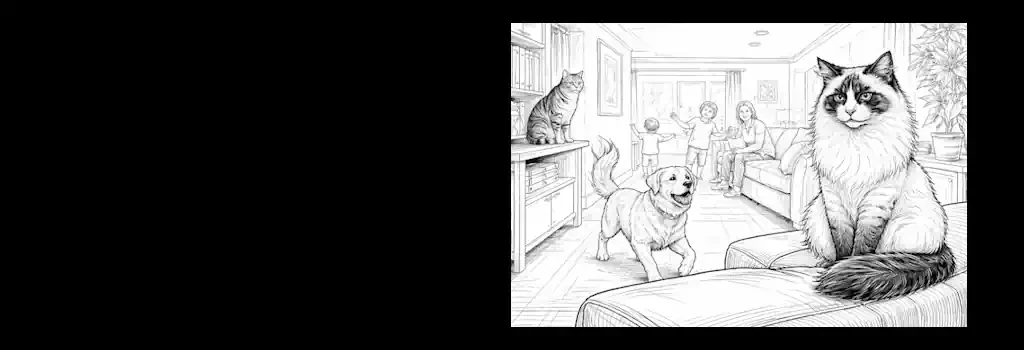
The dog noticed first.
Not in a thoughtful way. In a gravitational way. He moved toward me like motion was his only language, tail operating at a frequency that suggested optimism without data. Large, loud, convinced that proximity equals friendship. He didn’t mean anything by it, which is its own kind of problem. Intent doesn’t reduce impact. It just makes it harder to predict.
I did not run. Running invites pursuit. I did not advance. That would have been… ambitious. I stayed where I was and let him complete his orbit, which he did with enthusiasm and very little precision. He circled, sniffed, repositioned, and then lost interest just as quickly, pulled away by some other invisible priority.
That told me something useful.
The other cat did not move.
Different kind of presence. Elevated. Still. Watching from a place that had already been chosen long before I arrived. Not curiosity. Assessment. The kind that doesn’t need to hurry because it assumes time is on its side. No sound, no gesture, just a quiet claim written into posture and position.
I looked back. Not as a challenge. Just acknowledgment.
Hard to tell.
The humans filled in the rest of the room like background noise that occasionally becomes weather. Voices soft, movements careful, as if they believed this moment required choreography. They were wrong about that, but the effort was noted. They wanted this to go well, whatever that means.
I lowered myself to the floor without thinking about it. Not submission. Just economy. Standing too long in a new place suggests uncertainty. Moving too fast suggests something else. Stillness, used correctly, reads as intention even when it isn’t.
So I stayed there.
The house began to separate into pieces. Entryway, hallway, open room, elevated surfaces, narrow passages. Not territory. Not yet. Just structure. I watched how sound traveled, how light settled, how movement echoed. The dog’s path carved wide arcs. The other cat held angles and edges. The humans moved without pattern but with purpose they didn’t question.
I did not claim anything.
That was the first real decision, even if it didn’t feel like one. Nothing here belonged to me, and pretending otherwise would create a problem I couldn’t solve. I was not built for contest. I was built for something else, though it wasn’t clear what yet.
Probably both. Probably always.
So I took the smallest space available and made it sufficient. A patch of floor near the wall, close enough to observe, far enough to be ignored. From there, I watched the system breathe. Not chaos. Not order. Something in between that people like to call harmony when nothing is actively breaking.
That was the theory.
The house didn’t introduce itself. It repeated itself.
That’s how I started to understand it.
Morning came the same way twice, which is all it takes. Light moving across the floor in a line that pretends to be straight but never is, the dog waking up like he’s been launched into the day rather than eased into it, the humans performing small rituals that they believe are different each time. Food appears. Water shifts. Doors open and close for reasons that feel important to them.
I stayed low and watched.
The hallway turned out to be the spine. Everything passed through it eventually, which made it useful and dangerous at the same time. The dog treated it like a runway. Full speed, no consideration for who else might exist in the same space. The other cat used it differently. Slow crossings, deliberate pauses, stopping in the middle not because he needed to but because he could.
Ownership, expressed as inconvenience.
I adjusted by not being there when either of them was.
That sounds simple. It isn’t. Timing matters more than distance. I learned to listen before I moved. The dog announces himself long before he arrives. Nails on the floor, breath that carries, a rhythm that builds and then breaks as he changes direction for no reason I could detect. The other cat is quieter, but not silent. Weight shifts. Small sounds that don’t mean anything unless you’re waiting for them.
So I waited.
The rooms separated themselves into categories. Open spaces where movement expands and problems get bigger. Corners where everything narrows and decisions have to be made quickly. Elevated surfaces that change the entire conversation. Humans change the rules of a room just by sitting in it, which is strange but reliable.
I did not explore everything at once.
That’s how you make mistakes.
Instead, I moved in small loops. One room, then back. A little farther, then back again. Not claiming. Testing. The house started to feel less like a single place and more like a set of connected conditions. Each one with its own expectations, its own tolerances.
Hard to say.
The other cat watched these movements. Not constantly, but enough. He didn’t interfere. Not yet. That was more informative than aggression would have been. It meant I was not a threat. It also meant I wasn’t important.
Those are not the same thing, but they overlap.
The dog remained a variable. Predictable in his energy, unpredictable in his direction. He would pass through a room and change it without meaning to. A calm space becomes noise. A quiet moment becomes something else entirely. He doesn’t hold territory. He disrupts it.
So I let him pass through me without contact. I stepped aside early. Not reacting, just not being where he decided to be.
The humans thought this was going well.
Probably both.
By the end of the second day, I knew enough to avoid the obvious mistakes. Not all of them. Just the ones that matter early. Stay off the central line when the house is active. Use height when possible, but don’t linger where you can be cornered. Move when no one is paying attention. Wait when they are.
It wasn’t safety.
It was less risk.
The first conflict didn’t announce itself.
It didn’t need to.
I was in the wrong place at the right time, which is how these things usually happen. A narrow stretch between rooms, not quite the hallway but close enough to inherit its problems. I had waited. I had listened. Nothing obvious moved. So I stepped forward.
That was the mistake.
The other cat was already there, just out of sight, positioned in a way that made the space his by default. Not blocking. Not guarding. Just existing in it with the kind of certainty that turns shared space into a decision point.
I saw him at the same moment he chose to be seen.
No sound. Just presence.
We stopped.
There’s a moment in situations like that where the air tightens, like something invisible has decided to pay attention. He didn’t puff up. Didn’t hiss. That would have been easier. This was quieter. A look that said the line existed whether I recognized it or not.
The dog complicated it immediately.
He came in from behind, fast and unthinking, drawn by movement that hadn’t happened yet. Now there were three of us in a space built for one clean pass-through. Energy from two directions, neither coordinated, both convinced of their own logic.
I could have held my ground.
Some cats do. They expand, they declare, they turn the moment into a contest that ends one way or another. I am not built for that. Not physically, not structurally, not in the way my mind arranges choices.
So I didn’t.
I stepped back. Not sharply. Not as a signal. Just absence, introduced early enough that it didn’t become an event. The other cat advanced half a step, not to chase, just to confirm the space had resolved correctly. The dog overshot all of it, skidding slightly, confused that the situation had ended without him.
So much for drama.
I moved out of the corridor and into a wider room where the rules were looser. The air relaxed again, like it had lost interest. Behind me, the other cat held position for a moment longer, then turned away. The dog found something else to investigate, already committed to a different version of the world.
It was over before it began.
Hard to tell.
That was the lesson. Not about dominance. Not about fear. About timing and subtraction. The conflict existed because I entered a space that was already decided. It escalated because I stayed long enough to be part of it. It resolved because I removed myself before anyone had to prove anything.
No one won.
No one needed to.
Back in the open room, I settled near the edge, close enough to observe, far enough to avoid being included in whatever came next. My heart was steady. Not because nothing had happened, but because I hadn’t forced it to.
That was new.
Probably both. Probably always.
The house didn’t change after that. It didn’t reward me. It didn’t acknowledge the decision. It just continued, the same patterns moving through the same spaces, waiting for the next moment someone misread them.
I didn’t plan to be that someone again.
After that, I stopped pretending there was a single way to move through the house.
There were rules already in place. I hadn’t written them, but I was expected to follow them anyway. So I began to collect them, one at a time, the way you gather small objects that don’t look important until you need them.
The first was simple. Do not contest space.
That sounds obvious until you realize how often space presents itself like an invitation. An open stretch of floor. A doorway with no one in it. A chair that looks available. The mistake is believing availability means permission. It doesn’t. It means the decision hasn’t been enforced yet.
So I stopped taking the offer at face value.
If a space mattered, it would reveal itself by how others used it. The other cat didn’t rush. He occupied. He returned to the same places with quiet consistency, like the house had signed something only he could read. The dog didn’t care about ownership, but he changed the value of a space just by passing through it. Wide arcs, sudden entries, exits that made no sense.
I learned to see the aftermath instead of the moment.
The second rule followed. Do not hold ground.
Standing still is not neutral. It becomes a statement whether you intend it or not. If I stayed too long in one place, I became part of the structure, and structure invites challenge. Not always. Not immediately. But eventually.
So I stayed light.
Not restless. Just… temporary. I used spaces and then released them before they became something worth arguing over. A chair was a pause, not a claim. A corner was a checkpoint, not a destination.
That made me harder to measure.
Hard to say.
The third rule was the one that actually mattered. Move early.
Waiting until tension appears is already late. By the time the air tightens, the choices are limited and none of them are good. The better move is to leave before anything decides to happen. Not because something is wrong, but because it might be.
This requires a certain kind of attention.
I watched for small shifts. The other cat changing posture just slightly. The dog’s energy rising before he moved. The humans standing up, which meant the room was about to rearrange itself in ways they wouldn’t predict. Those were the signals. Not dramatic. Not clear. But consistent enough.
So I moved before they finished becoming something else.
Probably both.
The last rule wasn’t really a rule. More of a correction. Let others spend energy.
The dog burned through the house like it was temporary. The other cat invested energy in maintaining lines I had no interest in crossing. Neither of those costs belonged to me. I didn’t need to participate in them to exist here.
So I didn’t.
I conserved what I had. Not out of fear. Out of design. There’s a difference, even if it looks the same from a distance.
By the end of it, I wasn’t safer.
Not exactly.
I was just making fewer mistakes.
Once the rules settled, the house stopped feeling like a single place and started behaving like a map.
Not the kind humans hang on walls. Something more conditional. Areas that changed value depending on who was present, how fast they were moving, and whether anyone had decided to care about it in that moment.
I began with height.
Elevated surfaces rewrite the conversation. A table, a shelf, the back of the couch. Up there, the dog becomes a spectator, loud but limited. The other cat can still reach, but the approach changes. No straight lines. No easy pressure. It buys time, which is often enough.
I used height sparingly.
Staying too long makes it visible. Visible becomes predictable. Predictable becomes something the other cat will eventually test. So I treated elevation like a tool, not a refuge. Up when needed, down before it turned into a statement.
Then the narrow paths.
Doorways, edges of furniture, the thin spaces between objects that look insignificant until two bodies try to occupy them at once. Those are decision points. Entering them without information is a mistake. Entering them late is worse.
So I avoided committing to them unless I knew what was on the other side.
If I had to cross, I did it clean. No hesitation, no pause in the middle where uncertainty turns into exposure. Through and out. Nothing left behind that could be interpreted as intent.
The open rooms were different.
They feel safe because there’s space to move, but space also allows problems to grow. The dog accelerates there. The other cat can choose angles. You think you have options until you realize all of them are visible.
I stayed near edges.
Not hiding. Just… positioned. Close enough to step away without needing to explain why. Far enough that I wasn’t part of whatever center the room decided to form.
Hard to tell.
The human spaces added another layer.
When they sit, the room softens. Rules blur. The other cat relaxes his lines, not completely, but enough. The dog redirects toward them, attention pulled upward instead of outward. It creates a temporary corridor where movement is less likely to be questioned.
I used that.
Not constantly. Just when needed. Passing through their gravity without becoming part of it. They think it’s affection when I brush by. It’s not. It’s timing.
Probably both. Probably always.
Over time, the map filled in.
Not with ownership. With access. Places I could move through without resistance. Places I avoided because they asked questions I didn’t want to answer. Routes that only worked at certain times, when the house was distracted or already committed to something else.
I didn’t control any of it.
I didn’t need to.
The structure was already there. I just stopped arguing with it and started using it for what it was.
Territory sounds solid when you say it out loud.
It isn’t.
What matters is when a space is used, not who thinks it belongs to them. That took longer to settle in, because it runs against the way the other cat behaves. He returns to the same places, holds them, reinforces them, like repetition makes something permanent.
Maybe it does.
Just not in the way that helps me.
So I shifted from thinking about where to be to thinking about when to be there. The same chair means different things depending on the hour, the mood of the room, whether the dog has already burned through his first burst of energy or is still building toward it.
Morning is loose. The house is stretching into itself. Movements overlap but don’t collide yet. I can cross more freely then, take longer paths, test routes without committing to them.
Midday tightens.
The dog grows unpredictable in a different way. Not explosive, just restless, like he’s searching for something he won’t recognize when he finds it. The other cat becomes more deliberate, holding positions longer, watching more. Spaces start to carry weight again.
I reduce movement.
Not stopping. Just narrowing it. Short crossings. Quick decisions. Less time spent in places that might become important while I’m still there.
Evening changes everything.
The humans gather, and the house reorganizes around them. Attention shifts. The dog anchors himself near them, finally contained by something he respects. The other cat loosens his hold slightly, not abandoning it, just… allowing overlap he wouldn’t tolerate earlier.
That’s when the map opens.
I move more then. Longer paths. Access to areas that were closed without ever being labeled as such. Not because I’ve earned them. Because the conditions have changed and I’m paying attention to that.
Hard to say.
Timing becomes a kind of language. I don’t need to understand motives. I don’t need to negotiate. I just need to arrive when no one is asking questions and leave before they start.
The dog doesn’t track patterns. He lives inside each moment like it’s the only one available. That makes him easier in some ways. If he’s calm now, he’s calm. If he’s not, he’s not. There’s no strategy to it.
The other cat is different.
He remembers. Not in a human way, but in a structural one. Repetition matters to him. If I cross a space at the wrong time more than once, it becomes a pattern he will correct. Not immediately. But eventually.
So I don’t repeat mistakes.
Probably both.
By the time the house settles for the night, everything slows. Movement reduces to small adjustments, minor repositioning. The edges blur again. Ownership matters less when nothing is being contested.
That’s when I rest.
Not because it’s safe. Because it’s the closest thing the house offers to it.
Once I started paying attention to time, the others stopped looking random.
The dog, for all his noise, runs on a loop.
He wakes fast, spends energy like it’s renewable, then collapses into a stillness that looks almost thoughtful if you don’t know better. It isn’t thought. It’s depletion. Give him enough space and he will empty himself out without help. Interrupt him, and he resets.
That matters.
If I move while he’s full, I become part of the activity whether I intend to or not. If I wait until he’s burned through that first surge, he becomes background. Still large, still present, but no longer interested in making everything into motion.
So I let him spend himself.
The other cat is not a loop. He’s a pattern.
Slower, more deliberate, less obvious. He doesn’t move unless there’s a reason, and the reason usually involves maintaining something that already exists. A line, a position, a piece of the house that has been visited enough times to feel like a statement.
He doesn’t need to prove it often.
Just enough.
I began to see the shape of it. He favors certain paths, returns to certain heights, pauses in places that don’t look important until you notice how often he uses them. It isn’t aggression. It’s maintenance.
That’s harder to deal with.
Hard to tell.
Aggression you can react to. Maintenance you have to anticipate.
So I stopped thinking of him as a threat and started thinking of him as a system. Systems don’t hate you. They don’t even notice you unless you interfere with them. But if you do, they respond in ways that feel personal.
Probably both. Probably always.
There were small moments that confirmed it.
A doorway I crossed too often at the same time. The next day, he was there before I arrived, not blocking, just present enough to make the crossing a question. I didn’t push it. I adjusted the time, came through later, and he wasn’t there.
Not a coincidence.
The dog never learned anything like that. He doesn’t store patterns the same way. He experiences, forgets, repeats. That makes him easier to predict in a blunt way and harder in a fine one. He can change direction without warning because direction was never the point.
So I treated him like weather.
You don’t negotiate with it. You watch it, wait it out, move when it passes.
The other cat I treated like structure.
You don’t fight structure. You move around it, through it, sometimes under it, but never directly against it unless you’re prepared for what follows.
I wasn’t.
So I didn’t.
By then, the house felt less like something happening to me and more like something I was moving inside with a degree of choice. Not control. That would be too much. But awareness, which is close enough to matter.
I still made mistakes.
Just not the same ones.
The smaller humans arrived without warning.
They don’t enter a room. They happen to it.
The first time I saw them, I thought the dog had multiplied. Same energy, less coordination, more hands. They moved in bursts, then stopped completely, then moved again as if something inside them kept forgetting to stay still. Voices higher, faster, not directed so much as released.
I stayed where I was and let the moment pass through me.
That worked, mostly.
They noticed me the way the dog does, as a possibility. Not a threat, not an opponent, just… something that might respond if approached with enough enthusiasm. One of them came closer, hands already reaching before the distance had been decided.
I didn’t move.
Not because it was safe. Because I needed to see what they would do without interference. The hand landed on my back, too quick, too certain. Not rough, just unmeasured. Pressure without intention behind it.
I adjusted slightly. Not away. Just enough to change the angle, reduce the force, turn the contact into something I could tolerate.
They laughed.
That told me something I didn’t like.
Hard to tell.
The dog joined, of course. Movement attracts movement. Now the room had momentum again, but this time it was layered. The children moving in short, unpredictable lines. The dog weaving through them, amplifying everything. The other cat was gone, which meant he had already made his decision about this environment.
Avoid.
I followed his lead.
The difference is he leaves before it starts. I was already inside it.
So I shifted to exit.
Not fast. Fast triggers pursuit. I moved when their attention broke for a fraction of a second, when one looked at the other, when the dog redirected toward a sound. Those small gaps matter. I slipped through one and reached the edge of the room, then the hallway, then a higher surface where hands don’t reach without effort.
The noise stayed below.
So much for calm.
From there, I watched.
The children aren’t malicious. They don’t enforce lines the way the other cat does. They don’t burn energy the way the dog does. They do something else. They compress space without realizing it. They close distance quickly, then hold it without understanding what that means for anything smaller than they are.
That makes them… complicated.
Probably both. Probably always.
Over time, I adjusted.
I don’t stay at ground level when they enter a room. I don’t wait for contact to decide if I want it. I move early, the same way I do with everything else. Height becomes more important. Distance becomes non-negotiable. If I choose to approach, it’s brief and controlled, and I leave before their attention settles fully on me.
They think I’m shy.
That’s fine.
What I am is intact.
The house shifts when they’re present. Rules loosen in some places and tighten in others. The other cat disappears or watches from a distance, refusing to engage. The dog becomes louder, more chaotic, feeding off their movement.
I reduce my footprint.
Not because I have to. Because it works.
We observe, we wonder, and we accept.
The larger humans move like they believe the house belongs to them.
It does, in a technical sense. Papers, decisions, the quiet authority of things being where they left them the day before. But the house doesn’t answer to them the way they think it does. It bends around them, same as it does around everything else. They just don’t notice the bending.
I noticed.
They enter a room and change it without trying. Chairs get used instead of passed. Floors become pathways instead of open fields. The dog orbits them, pulled into a tighter pattern, energy redirected into something that looks like obedience if you don’t examine it too closely. The other cat adjusts as well, not yielding, just… shifting his lines to account for a larger force that isn’t interested in his rules.
I stay at the edge and watch.
The adults bring a kind of temporary gravity. Not constant. It comes and goes. When they sit, the room settles. Movement slows, edges soften, the sharpness of certain spaces dulls just enough to allow crossing without consequence. It isn’t safety. It’s a window.
I use it.
Not in a way they would recognize. I pass through their space when they’re engaged with something else, when their attention is focused inward on their own concerns. A conversation, a screen, the small rituals they repeat without thinking. In those moments, the dog quiets, the other cat loosens, and the house opens.
Probably both. Probably always.
They interpret this as trust.
I let them.
There are times when they reach for me. Slower than the children, more measured, as if they’ve learned something about limits but not quite enough to understand them fully. I allow contact on my terms. Brief. Controlled. I position myself so I can leave without friction. If a hand lingers too long, I step away before it becomes a question.
They think I’m gentle.
That’s close enough to the truth.
Hard to say.
They also interfere, though they don’t see it that way. A door closed at the wrong time changes the map. A sudden movement redirects the dog, which redirects everything else. They pick up the other cat and place him somewhere new, breaking a pattern he will later reestablish with more emphasis. They call my name as if sound has authority.
It doesn’t.
But it shifts attention, and attention is enough.
I don’t rely on them.
That’s the part that matters. They are not a system I can predict with precision. Too many variables. Too many decisions made for reasons that don’t repeat cleanly. So I treat them like weather with occasional structure. Useful when stable, disruptive when not.
I adjust in real time.
When they’re calm, I expand my movement. When they’re active, I reduce it. When they gather, I pass through. When they scatter, I wait. They create openings without intending to and close them just as quickly.
So I don’t commit to anything they create.
That was a mistake I made once. A lap offered, a stillness that looked permanent. It wasn’t. The shift came without warning, and I had to disengage faster than I prefer. No harm done, but the lesson stayed.
Nothing here is fixed.
The adults believe they run the house. The dog believes he experiences it. The other cat believes he defines it.
I move through it.
We observe, we wonder, and we accept.
It didn’t happen all at once.
Nothing here ever does.
Acceptance sounds like a decision you make and then keep. It isn’t. It’s something that settles in slowly, the way a room changes temperature when no one is paying attention. You notice it later and realize it’s been that way for a while.
I stopped looking for a different version of the house.
That was the shift.
Not a better one. Not a quieter one. Just… different. I had been watching everything like it might rearrange itself if I understood it well enough. Like there was a configuration where the dog moved with intention, the other cat shared without calculation, the humans acted with consistency.
That version never arrived.
So I let it go.
Hard to say.
The rules didn’t change. The map didn’t change. The timing, the paths, the careful movement through spaces that weren’t mine to hold. All of that stayed exactly the same. What changed was the expectation that it should feel like something else.
It doesn’t.
The dog still burns through the house in loops that begin and end wherever he decides they do. The other cat still maintains his quiet lines, reinforcing them with presence instead of noise. The humans still shift the structure without understanding how or why.
Probably both. Probably always.
And I still move the way I move.
Early, not late. Edges, not centers. Timing over territory. I leave before I’m asked to stay and stay only where leaving is easy. None of that softened. None of it needed to.
But it stopped feeling like work.
That’s the part I didn’t expect.
There’s a difference between surviving a system and living inside it. Surviving is constant calculation, every movement measured against what might go wrong. Living is… quieter. The same calculations are there, but they don’t announce themselves anymore. They run underneath, the way breathing does.
I don’t think about most of it now.
I just do it.
The house continues the way it always has. Small collisions avoided. Larger ones never allowed to form. Paths taken and released. Spaces used and forgotten. Nothing claimed. Nothing contested.
Nothing fixed.
That used to bother me.
Now it doesn’t.
So much for certainty.
There are moments, brief ones, where everything aligns. The dog asleep, finally empty. The other cat watching without enforcing. The humans still, the room settled into something that almost resembles peace if you don’t look at it too closely.
I exist in those moments the same way I exist in the others.
Without argument.
We observe, we wonder, and we accept.