Today, students, we're going to dive into the Bengal cat, not merely as a runway model, though they certainly could be, but as a fascinating exercise in genetic architecture and behavioral paradox. It's a creature stitched together from disparate threads, a testament to what happens when we decide to play a bit of evolutionary chess.
We will begin by talking about how you build a walking contradiction. A cat that thinks it’s still in the jungle, even as it’s debating the merits of kibble versus salmon paté in your kitchen. Hard to be sure what they're truly thinking. We’ll examine the origins, the very blueprint, and then, of course, the inevitable complications, along with other information.
Genetic Origin and Development
Next, students, we're going to pull back the curtain on something rather audacious, a project that took the raw, untamed essence of the wild and attempted to filter it, to refine it, into something suitable for a sunbeam on your living room rug. It's the story of how we decided that a domestic cat wasn't quite enough, that it needed a dash of the jungle, a sprinkle of the savanna, without, you know, the actual teeth and claws of the savanna. This, my eager scholars, is the genetic genesis of the Bengal cat, a tale of selective breeding, ambition, and a fair bit of sheer stubbornness.
The core idea was simple enough in its terrifying ambition: take Felis bengalensis, the Asian Leopard Cat, a creature built for stealth and survival in its native lands, and cross it with Felis catus, your common-or-garden domestic house cat. The Asian Leopard Cat, or ALC, is a lithe, spotted animal, solitary by nature, a hunter of small prey. It carries that distinct, rosetted coat that makes you think of larger, more dangerous felines. The goal, as envisioned by pioneers like Jean Mill in the 1960s, was to capture that breathtaking aesthetic, that wild beauty, and graft it onto a pliable, purring, lap-sitting companion. It was an exercise in biological alchemy, really, attempting to turn lead into gold, or in this case, a wild cat into a domesticated one with excellent camouflage.
The early breeding programs were, shall we say, a logistical tightrope walk. You start with the first generation, the F1, a direct cross between the wild ALC and a domestic cat. These offspring often retained a significant portion of their wild parent's personality. They were wary, often aloof, not exactly keen on cuddle time or predictable meal schedules. Imagine trying to explain the concept of a litter box to something that still dreams of hunting rodents in a rice paddy. It required a certain commitment, a willingness to accept that your new pet might view you less as a benevolent provider and more as a slow-moving, food-dispensing tree.
Then came the F2 generation, the F3, and so on. The aim was to dilute the wild instincts with each successive generation, maintaining the visual splendor while enhancing the domestic temperament. It wasn't always smooth sailing. Early generation male Bengals often proved sterile, a common hiccup in interspecies hybridization, like a grand administrative oversight in the biological bureaucracy. So much for that plan. Breeders had to navigate these genetic roadblocks, carefully selecting fertile individuals, often female F1s or F2s, to continue the line. It was a painstaking process, a genetic funnel, filtering out the raw wilderness until only the desired traits remained, or so they hoped.
They blended in a variety of domestic cats initially: Abyssinians for their elegance, Egyptian Maus for their sleek lines, even some Ocicats for their spotting patterns. It was a genetic melting pot, all in pursuit of the perfect paradox: a cat that looked like it just wandered out of the jungle, yet knew perfectly well how to use a scratching post and demand attention with a well-placed head-nuzzle. The outcome, after decades of dedicated effort and a fair few scratched hands, was remarkable. The Bengal cat we know today is usually considered "domesticated" from the F4 generation onwards, meaning they are four generations removed from their wild ancestor. They possess those striking patterns, that muscular build, that athletic grace. We observe, we wonder, and we accept the strange beauty of it all. They still have a high energy level, a penchant for water, and a cleverness that can border on mischievous, reminding you that deep down, a bit of the wild still hums in their veins. Hard to tell if they ever truly forget their heritage.
So, from a rather ambitious twinkle in a breeder's eye, through generations of careful pairing and even more careful temperament selection, emerged a breed that successfully straddles two worlds. It's a living, breathing paradox, a testament to what can be achieved when humanity decides to improve upon nature, or at least, give it a stylish makeover.
Distinctive Physical Characteristics
Alright class, we've dissected the invisible threads of their lineage, the careful weaving of wildness into the domesticated fabric. Now, let’s talk about what hits you first, what makes a Bengal cat instantly recognizable across a crowded room of housecats, of course it's the sheer, undeniable presence of its physical form. It’s a blueprint for a miniature jungle, packed into a surprisingly compact package.
You gaze at one of these animals, and your mind doesn't register "fluffy companion." No, you see a finely tuned machine, sculpted for purpose. Their bodies flex with a lean, athletic tension, a low-slung power that speaks of ancestors who navigated dense foliage rather than plush sofas. Muscles coil beneath their patterned fur, shifting with every deliberate step, every stretch that seems to unspool their entire length. They move with an almost liquid grace, silent and efficient, as though mapping out escape routes and pouncing trajectories even when merely ambling across the kitchen floor. It’s not just strength; it's a dynamic, kinetic intelligence, carved into their very bones.
Then there’s the face, a masterpiece of primal elegance. Their eyes, often a striking green or gold, sit wide apart, oval pools that hold a disconcerting depth, a gaze that seems to measure you, to catalog your movements. Those cheekbones push high, sculpting a fierce, almost predatory expression, quite unlike the softer contours of more traditional domestic breeds. A broad, substantial bridge anchors a nose that speaks of keen senses, not just idle sniffing. And the ears, small and rounded, they rotate on their axis, tiny, alert satellites constantly scanning, absorbing every whisper of the immediate vicinity. You look into that face, and the ancient wildness, the untamed spirit, it just stares back.
Hard to tell if it's a trick of the light or true intention, that look.
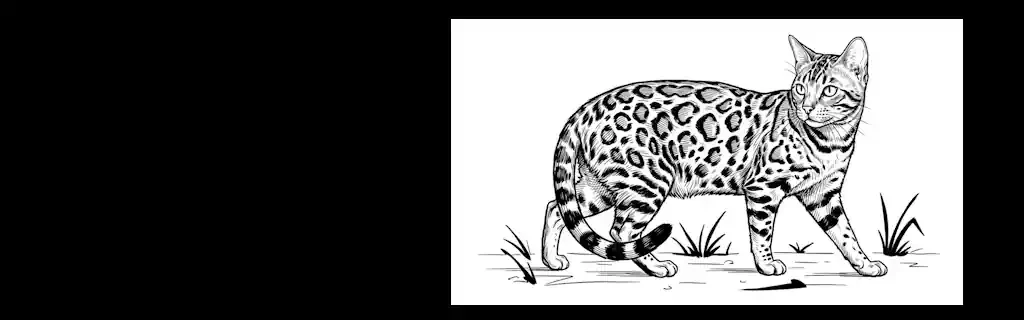
And the coat. Ah, the coat. This is where the magic truly lives. It feels like sheared velvet, surprisingly dense yet incredibly soft beneath your fingers. It's not merely patterned; it's a three-dimensional landscape of rosettes, marbling, and intricate spots that don't just lie flat on the surface. These markings sometimes feel slightly raised, giving the pelt a rich texture. But the real marvel, the secret jewel, is the "glitter" gene. This isn’t a myth, I promise you. Their fur literally shimmers, tiny iridescent flecks catching the light, making the cat appear as if it’s been sprinkled with gold dust or fine, crushed glass. It’s a remarkable, almost impossible visual effect, as though their very essence captures and refracts the world around them. It still sheds, of course. Everything sheds.
So, from their sinewy frame to the intelligent architecture of their faces, down to the very microscopic structure of their shimmering pelts, Bengal cats present an aesthetic that consistently harkens back to their wild origins. They are, in a very real sense, walking tributes to a carefully orchestrated genetic endeavor, a living paradox of design.
Analysis of Coat Patterns and Colors
Alright, let's turn our attention to the visual lexicon, the very hieroglyphics these remarkable creatures wear on their backs. The Bengal cat’s coat isn't merely a covering; it’s a living, breathing tapestry, an intricate piece of genetic engineering, a statement to the world, if you will, about their heritage. We’re talking about patterns and colors that stand alone in the domestic feline world, a deliberate echo of their wild ancestors, yet honed for the suburban sofa.
We largely categorize these patterns into two main branches: the spotted and the marbled. The spotted, as you might guess, are what most people immediately recognize. But these aren't your average tabby spots. Oh no. The true Bengal spots are what we call "rosetted." Imagine a bullseye, or perhaps a scattered collection of ink blots, where the center is a different shade than the outline. These rosettes can be open, like a horseshoe, or closed, forming a full circle, often with a lighter interior than the darker edges. They are nature's own camouflage, designed to break up an outline in the dappled light of a jungle, even if that "jungle" is now a living room rug. Some Bengals just have single spots, like dark sprinkles across a lighter base. Hard to say which is more effective at stealing snacks from the counter. Probably both. Probably always.
Then we have the marbled pattern, a truly spectacular visual departure. Instead of distinct spots, you see swirling, horizontal streaks and bands, like liquid chocolate poured over cream, or perhaps a rather chaotic geological survey map. The ideal marble pattern should flow horizontally, not break vertically into what we call "bullseye" markings, which breeders, in their infinite wisdom, consider a fault. It gives the cat an almost liquid appearance, as if their fur is constantly in motion. It's an illusion, of course, but a rather effective one.
Now, on to the colors, because a pattern is only as captivating as the palette it rests upon. The most common, and perhaps the most archetypal, is the brown Bengal. This color range is vast, stretching from a warm, golden honey to a deep, rich mahogany, all accented by those dark, almost black patterns. The contrast, the depth of color, it's what screams "wild" without them actually needing to hunt your remote control. Their bellies, typically, maintain a lighter hue, often cream or white, another little nod to the wildcat blueprint.
"Professor?" A young woman in the second row, her glasses perched low on her nose, raises a hand. "I’ve seen some Bengals that look... white. Are those a different color variant entirely, or just a very light brown?"
Ah, an astute observation. You’re likely referring to what we term "snow" Bengals. And no, they're not merely a pale brown. This is where things get a touch more complex, genetically speaking. The snow Bengal comes in three primary variations, each stemming from different forms of the temperature-sensitive albinism gene. We have the Seal Lynx Point, which exhibits the deepest contrast in patterns on a very light, almost white background, and always, always those striking blue eyes. Then there's the Seal Mink, a slightly warmer creamier base, with patterns that show a medium contrast, often accompanied by aqua or green eyes. Finally, the Seal Sepia, the warmest of the snows, with a more golden-cream background, higher contrast patterns, and gold or green eyes. It’s a bit like ordering coffee; same basic concept, but endless variations in strength and color.
And, not to be overlooked, we have the silver Bengal. This isn't a true color gene like brown or snow, but rather an inhibitor gene that suppresses warm pigment. It transforms the brown into a cool, almost steel-grey or sparkling white background, against which those black patterns stand in stark, dramatic relief. It’s the visual equivalent of a winter landscape: crisp, clean, and quite breathtaking. So, you see, it's not just a cat with spots; it's a carefully curated work of art, a living blueprint of genetic possibility. We observe, we wonder, and we accept.
The Phenomenon of Glitter
We've peered into their ancestry, charted the complex cartography of their patterns, and even admired the sheer athletic prowess etched into their very bones. But there remains, students, a subtle, almost ethereal quality to the Bengal's coat, one that transcends mere color or design. I refer, of course, to the phenomenon we so affectionately, and perhaps a touch unscientifically, call "glitter." It's not a pigment, not a dye, nor a product of careful grooming. It’s an architectural marvel of the individual hair shaft itself, a testament to nature's relentless pursuit of the aesthetically compelling, or perhaps, simply a charming accident that the breeders, those tireless taxonomists of beauty, recognized and preserved.
This metallic shimmer, this internal luminosity that seems to emanate from the very depths of their fur, isn't some surface treatment. It's far more intricate, a sophisticated optical trick played out on a microscopic scale. Each guard hair, those sturdier, longer filaments that form the outer protective layer of the coat, possesses an unusual translucency in its outer sheath. Think of a tiny, hollow glass tube, perfectly clear, allowing light to penetrate its walls. That's a reasonable, if slightly simplified, mental model for what's happening.
A young woman in the second row, ever the keen observer, raises a hand, a look of genuine curiosity etched on her face.
"Professor, so the hair is like… see-through?"
You're close, very close. The outer layer, what we call the cortex, holds little to no pigment. Light, that relentless traveler, plunges straight through this translucent sheath, unimpeded. It then encounters the deeper layers of the hair, where the actual color pigments reside. Rather than simply absorbing or reflecting the light directly, the internal structure of that hair shaft acts like a multifaceted prism, scattering and refracting the light, bending it, breaking it, sending it bouncing in myriad directions before it finally emerges again. The effect is less a straightforward reflection, more a light show happening within the fur itself, creating that characteristic sparkle, that almost liquid-metal quality. It makes the fur look wet, sometimes, even when it is perfectly dry.
It’s a peculiar adornment, this glitter. Not strictly necessary for survival, I suppose, unless one considers dazzling potential mates a survival trait, which, for some species, is certainly the case. But for the Bengal Cat, it is a hallmark, a genetic flourish that elevates their wild aesthetic to something truly captivating, a subtle declaration of their unique lineage. It's a lot of fuss over fur, I suppose. Hard to tell.
Temperamental Traits and Intelligence
Alright, so we've admired the Bengal's outward splendor, a coat that shimmers like scattered starlight, a physique honed for the wild without, mercifully, quite having to live it. But what good is a magnificent exterior if the interior is, shall we say, bland? Now, we pivot from the visual spectacle to the internal dynamo, the intricate wiring beneath the glittering fur. We're talking temperament, intelligence, and the sheer, glorious inconvenience of their existence.
These creatures, they operate on a different scale of kinetic energy. Imagine a perpetual motion machine fueled by existential curiosity and the faint scent of something interesting just beyond reach. They don't simply walk into a room; they choreograph an entrance, usually involving vertical leaps and a thorough inspection of the ceiling fan. They need an outlet, a genuine arena for their athletic prowess, not just a decorative perch in a sunbeam. Without it, well, your carefully curated domestic landscape becomes their personal jungle gym, and gravity, for them, is merely a suggestion, not a rule.
A hand shot up from the back, belonging to a student usually found sketching intricate geometric patterns on their notebook.
“Professor,” the student asked, "is it true they can open things? Like cupboards and doors?”
They absolutely can. A closed door is not a boundary to a Bengal; it's a personal affront, a challenge issued directly to their superior intellect. They study mechanisms, these cats, not with the laborious logic of a human, but with the intuitive grasp of a natural-born engineer. A latch, a knob, a sliding bolt – these are merely variables in a complex equation they are determined to solve. I once witnessed a particularly tenacious specimen dismantle a childproof lock, not through brute force, mind you, but by systematically testing every possible angle of attack, a tiny, furry Bletchley Park in action. It took less than fifteen minutes.
Hard to tell if it was genius or just pure, unadulterated stubbornness. Probably both.
Then there's the social contract. Some cats are content to be admired from a distance, like a particularly rare stamp. Not the Bengal. They are full participants in the human experiment, often to an exhausting degree. They demand engagement, not just your presence, but your active, undivided attention. They'll follow you from room to room, a shadow with an opinion. They'll initiate games of fetch, often dropping the retrieved item precisely where it's most inconvenient for you to bend down and pick it up. They integrate themselves into the very fabric of your daily routine, demanding their narrative arc be interwoven with yours. It's a level of investment they expect from their human, a deep, abiding interest in their daily exploits and philosophical musings, which often revolve around the structural integrity of your curtains.
So, when we consider a Bengal, we aren't simply admiring a beautiful pattern; we are acknowledging a vibrant, demanding, and utterly captivating intellect that requires more than just a bowl of kibble and a warm spot to nap. They are a force, these animals, a living, breathing testament to nature's refusal to be easily contained.
Aquatic Affinity and Play Behavior
Alright class, we've explored the physical marvels and the keen intellect of the Bengal cat. Next, we delve into some of their more… eccentric predilections, behaviors that truly set them apart from their more languid domestic cousins. We're talking about an animal that views gravity as a suggestion, and water as an invitation.
Most house cats eye a running faucet with a mixture of suspicion and vague disinterest, perhaps a quick lap if the bowl is empty. Bengals? They practically see a personal water park. The tap becomes a geyser to be pawed at, the bathtub a miniature ocean for exploration, a place to bat at the ripples created by a clumsy foot. They are not merely drinking; they are engaging with the liquid, often dunking their toys, or just their entire head, for the sheer joy of the splash. It's a curious thing, this aquatic fascination, a throwback to some deep, forgotten instinct, a small, spotted river otter trapped in a cat’s fur coat. Hard to be sure.
Beyond their watery exploits, Bengals possess an undeniable, almost architectural, need for vertical dimension. A room to them isn't just a floor plan; it’s a three-dimensional landscape waiting for conquest. High shelves are not storage; they are observation posts. The tops of doors become precarious perches from which to survey their dominion. You find them atop cabinets, scaling curtains with the casual grace of a jungle cat navigating vines, which, in a very real sense, they are. They require elevation, a vantage point, to properly manage their small empire, or perhaps just to get a better angle on the unsuspecting dust bunny.
And this kinetic energy, this insatiable curiosity, demands a constant, intellectual counterpoint. These aren't creatures content to simply nap in a sunbeam all day, though they do appreciate a good snooze. They need stimulation, games that challenge their clever minds, puzzles they can dismantle. Without consistent interaction, without the mental gymnastics, your well-appointed home rapidly transforms into their personal adventure playground, often to the detriment of your decorative sensibilities. They are masters of the intricate game, demanding partners in play, and the moment you forget this, they invent their own amusements. Probably always.
So, when considering a Bengal, remember this: you aren't merely adopting a pet; you're inviting a small, spotted force of nature into your home, a creature that thrives on engagement, on high places, and on the delightful, often messy, allure of water. It makes for an interesting life.
Dietary and Nutritional Requirements
Right, so we've established the Bengal cat as a creature of exquisite design, a living sculpture of muscle and motion. A kinetic marvel, if you will, constantly in search of a new theory to test, usually involving gravity or the structural integrity of your curtains. This kind of high-octane engineering demands particular fuel. You can't run a finely tuned racing machine on discount petrol and expect it to, well, race. You need the good stuff.
Their dietary requirements, then, are less a suggestion and more a physiological mandate, echoing their wild ancestors who didn't exactly graze on wheat fields or nibble artisanal vegan patties. These cats are obligate carnivores, a classification that, much like a monarch's decree, leaves very little room for debate. Their digestive systems, their entire biological apparatus, evolved to process animal protein and fat. Anything else is, frankly, a bit of a burden.
"Professor?" A young woman in the third row raises her hand, a diligent sort, always jotting notes.
Yes, dear.
"Does that mean they shouldn't eat, like, normal cat food?" Her brow furrows slightly, a question mark hovering above her head.
Ah, "normal." A word we've often tried to define, usually without success. Many commercial cat foods, sadly, contain what I like to call "filler" – grains, carbohydrates, things a feline body, particularly a Bengal's, struggles to utilize efficiently. Imagine trying to explain quantum physics to a brick. It might eventually grasp the concept, but it's going to take a lot of effort, and the brick might not feel so great afterwards. Bengals, with their incredible muscle mass and boundless energy, need protein, and they need good protein. Think lean meats, poultry, fish. The kind of stuff that fuels a predator. Their metabolic rate, that internal furnace, burns hot and fast, demanding a constant, high-quality supply of amino acids to maintain that physique, those reflexes. It’s an endless biochemical performance.
These cats need a diet rich in animal protein, typically around 40-50% minimum, and healthy fats for energy. Their bodies are not designed for a high carbohydrate intake; it’s like trying to power a jet with molasses. It gums up the works, leads to a whole host of digestive issues, and frankly, makes them feel pretty rotten. We observe, we wonder, and we accept: they are little meat-eaters, pure and simple.
So, when we talk about keeping a Bengal healthy, truly thriving, we're talking about a commitment to nutrition that reflects their magnificent, albeit domestically contained, wildness. It's the silent engine behind all that glittering fur and relentless motion.
Hereditary Health and Longevity
Alright, so we've admired the glitter, the spots, the sheer athletic audacity. We've talked about what makes a Bengal a Bengal, genetically speaking, on the outside, and what they do to your curtains. We've even touched on their aquatic ambitions, which frankly, defies much of what we assume about the feline condition. Now, we shift our gaze, as all good observers must, to the more fragile architecture beneath the fur, the stuff that determines if they live to be a venerable old cat or if fate snips the thread a bit sooner. We're talking about health, specifically, the blueprints they come with, the ones sometimes carrying a few structural flaws. Longevity, for all its grand implications, often hinges on the very small, the very unseen.
One of the more prominent hereditary concerns in the Bengal population is Hypertrophic Cardiomyopathy, or HCM. It's a rather grand term for a heart muscle that decides it wants to be thicker, more substantial than it ought. This thickening, rather counterintuitively, makes the heart less efficient at its primary job, pumping blood. Think of it like a meticulous, self-improving machine that over-engineers its own pump, but the modifications actually choke the flow. The heart tries harder, works harder, but ultimately, it's a losing proposition. It's a silent operator, often without outward signs until the condition becomes critical, which is a rather cruel trick nature plays.
A young man in the third row lifts his hand, a slight frown etched across his brow.
"So, like, they just suddenly get sick, Professor? No warning signs at all?"
Sometimes, yes, that's precisely how it manifests. A sudden collapse, an unexpected passing. Other times, you might see subtle lethargy, a diminished appetite, but these are often so vague they can be attributed to almost anything. Responsible breeders, the ones not just chasing a pretty pattern, screen their cats rigorously, using echocardiograms to peer into those little hearts and detect the early signs. It's an ongoing battle against the genetic lottery.
Then we have Progressive Retinal Atrophy, or PRA. This condition, another joy of genetic inheritance, causes a gradual degeneration of the retina. It’s a slow dimming, a fading of the lights in the eyes, eventually leading to blindness. It's not a sudden, dramatic loss, more like a sunset that never quite ends, leaving the world in perpetual twilight for the affected cat. Again, genetic testing exists, allowing breeders to identify carriers and prevent passing the gene along. Without such care, you get a cat that might bump into furniture more often than you'd expect, finding their way by memory and scent instead of sight. Hard to tell if they truly mind, or if they simply adjust. Probably both. Probably always.
Bengal cats, despite these predispositions, generally enjoy a robust lifespan, often living into their early teens, sometimes longer, if the genetic cards fall right and they receive appropriate care. Their high energy, their particular dietary needs, all contribute to a life that demands a bit more from their carbon-based partners. But the wild side, the very thing we adore, means their internal systems carry echoes of a past where robustness was survival, and frailty often meant swift oblivion. We observe, we wonder, and we accept.
Integration into the Domestic Environment
Alright, let's turn our attention, if you please, to the integration of these magnificent creatures into the domestic sphere, a challenge often underestimated by those seduced purely by the shimmer of their coats. We've spoken of their wild heart, their undeniable intelligence, and their singular need for activity; now we must consider how that translates into cohabitation, particularly regarding their quite potent predatory instincts and their potential compatibility, or lack thereof, with the other inhabitants of your humble abode. It’s a delicate dance, a negotiation between instinct and a well-curated living room.
A Bengal, you see, carries the ghost of the jungle in its stride. Their predatory instincts are not merely vestigial; they are a vibrant, active component of their being. A toy mouse is not just a toy mouse; it is prey, worthy of a full, stalking approach, a calculated pounce, and a vigorous, often dismembering, shake. This isn't aggression; it's just efficient hunting, a system working precisely as it was designed, except now the savanna has shrunk to the rug in your den. Management of this involves not suppressing it, an impossible feat, but rather redirecting it. Interactive play, puzzle toys that simulate a hunt, and vertical spaces for observation, these are not suggestions; they are peace treaties signed in advance. If you fail to provide these, they will invent their own amusements, and your household trinkets, or perhaps even your toes, will become the unwitting participants in their grand safari. Probably both. Probably always.
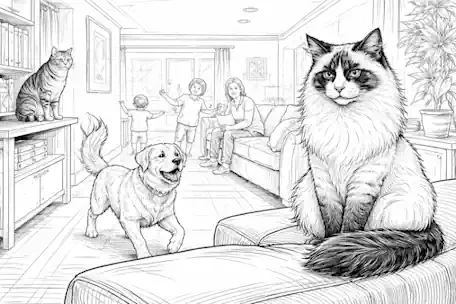
Now, as for other pets, this is where the waters get truly murky. Bengals can, and often do, coexist peacefully with other household animals, given proper introductions and a suitable temperament on all sides. Another domestic cat, if robust enough in spirit and body, can become a playmate, though a Bengal's play can sometimes feel like an invasion to a less kinetic feline. Dogs are often surprising allies, especially larger, more easygoing breeds that are accustomed to energetic companions; a mutual respect can form, often fueled by shared naps and the occasional chase. But a hamster? A parakeet? A tank full of tropical fish? Those are not potential friends. Those are, to the Bengal mind, a live-action documentary on natural selection, starring them as the intrepid, apex predator. We observe, we wonder, and we accept this immutable fact of their being, though perhaps not the hamster's.
And children. Oh, the small humans. Bengals can be wonderful family pets, full of affection and playful energy. They love to be involved, to observe, to participate in the general chaos of a household. However, their sheer kinetic force, that coiled spring energy, can be a lot for a very young child. A Bengal’s idea of playful pouncing or a swift, mock-hunt across the floor might be misinterpreted by little ones, or result in accidental scratches from claws that aren’t retracted quite quickly enough. Education, then, becomes paramount, teaching children how to interact respectfully, and teaching the cat that small, loud, fast-moving things are not, in fact, small, loud, fast-moving prey. It's an ongoing curriculum, a constant process of refinement, and the outcomes are, like many things in life, never entirely guaranteed. They are, after all, just cats.
So, the integration of a Bengal cat into your domestic tableau is less about training out their inherent nature and more about crafting an environment that honors it, providing outlets for their wildness within the confines of a safe, stimulating home. It’s about understanding their needs, respecting their instincts, and appreciating the unique, vibrant life they bring to your world.
Legal Classifications and Generation Grading
Alright, let’s shift gears from biology to bureaucracy. A necessary evil.
You see, the Bengal cat exists in a legal and taxonomic gray zone that varies not just by country, but often by county or city. The wild ancestor, the Asian Leopard Cat, is a regulated wildlife species. Its hybrid offspring? That’s where the paperwork begins.
The system uses a generational code. An F1 Bengal is the first filial generation, one parent is an Asian Leopard Cat, the other a domestic cat. They are, for all intents and purposes, half wild. Male F1s are almost always sterile. An F2 is the offspring of an F1 and a domestic cat. An F3, the offspring of an F2 and a domestic cat, and so on.
By the fourth generation removed from the wild ancestor, the F4, the cat is considered “domesticated” for most breeding registry purposes, like TICA. But here’s the catch: “domesticated” in a registry’s eyes is not the same as “legal” in a municipality’s eyes. Some places ban ownership of any cat with a wild ancestor within five generations. Some within three. Hard to tell.
Then you have the SBT designation. “SBT” stands for “Stud Book Traditional.” It means the cat is at least four generations removed from any wild ancestor. An SBT Bengal has only other SBT Bengals in its immediate three-generation pedigree. This is the only classification eligible for championship status in shows. It’s the bureaucratic seal of pure domesticity.
A hand goes up in the back. A young man with a frown. “So if I buy an SBT Bengal, it’s just a normal cat, legally?”
I wish it were that simple. You might have an SBT pedigree from a breeder in one state, but if you move to another, their animal control laws might define “hybrid” by species percentage, not by pedigree. Your perfectly legal, championship-quality SBT might be classified as a regulated wild animal because of a great-great-grandparent it never met. The law often lags a few decades behind the genetics.
You must research your local laws as diligently as you research your breeder. The cat might be generations removed from the jungle, but the law sometimes hasn’t left it at all. Hard to tell.
Conclusion
Alright, settle down. We observe, we wonder, and we accept. That’s the whole job, really.
You’ve got the blueprint now, the wild architecture, the glittering facade, the engine that never quite idles. You know the legal paradox, the dietary demands, the heart that can betray its own design. You know they will open your cabinets and judge your water glass collection and consider your curtains a personal challenge.
The goal was never to tame the wilderness. It was to build a home where the wilderness could live, safely, beside you. To negotiate a peace treaty with a small, spotted sovereign state.
So that’s the syllabus. The rest is fieldwork. Go observe.
Class dismissed.