The documented origins of the Maine Coon do not begin with romance, nor with shipwrecked royalty clutching wicker baskets, nor with woodland scandal involving raccoons and improbable biology. They begin, as most durable things do, with weather and work and the quiet arithmetic of survival in a place that does not negotiate with winter. Maine in the eighteenth and nineteenth centuries was not a backdrop; it was a filter. Cats arrived there the same way people did, by ship and by accident and by necessity, and those that stayed were not the delicate or the ornamental but the ones who could step into snow without complaint and still return with a barn mouse before dusk. The story, when stripped of embroidery, is practical. Which is oddly comforting .
Early settlers and seafarers brought long-haired cats from Europe, animals suited to damp holds and rat patrol more than parlor admiration. Once ashore in New England, these cats found themselves in a climate that rewarded density and punished fragility. Over time, and without committee oversight or breed registries to supervise the proceedings, a type began to stabilize. Not a sudden invention. Not a dramatic unveiling. A slow agreement between fur and frost.
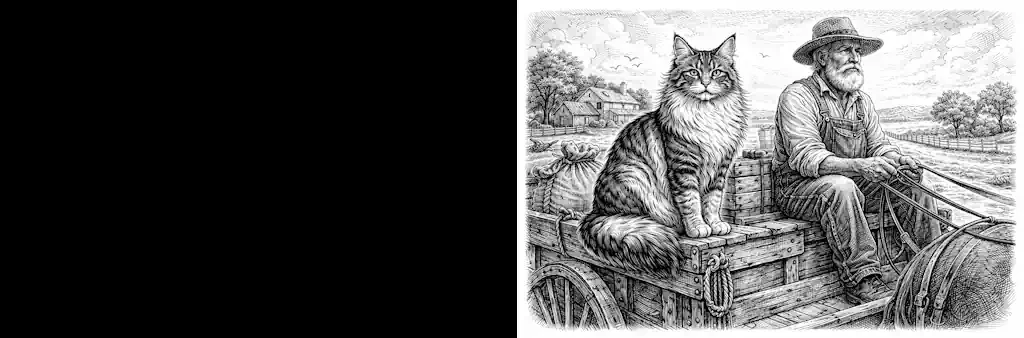
By the mid-1800s, accounts of large, long-haired cats in Maine farms and port towns were common enough to be unremarkable, which is often how genuine origins behave. They do not announce themselves. They accumulate. Farmers valued them not for symmetry or show posture but for competence. A working cat did not need an origin myth. It needed to keep grain stores intact and mice sufficiently nervous.
There is documentation of Maine Coon–type cats appearing in early American cat shows in the late nineteenth century, including the famous 1895 Madison Square Garden show in New York, where a brown tabby Maine Coon named Cosey won Best in Show. That fact, dry as ledger paper, matters because it anchors the breed in recorded history rather than anecdote. The cats were recognized not as curiosities but as specimens with consistent traits. Large frame. Long, weather-resistant coat. Tufted ears. A tail thick enough to argue with gravity.
What is striking about these early records is their lack of drama. No official moment of creation. No architect. The Maine Coon was not designed. It was tolerated by winter and endorsed by utility. In that sense, it resembles certain old houses along the coast, built without blueprints but standing because they adapted each season without protest.
The environment did most of the editing. Cats with thinner coats did not fare as well in long stretches of cold. Smaller frames were not always advantageous in barns where strength and endurance had practical consequences. Those who could conserve heat, who could move across snow without sinking to the elbow, who could endure damp wind off the Atlantic, persisted. Generation by generation, the outline sharpened.
By the early twentieth century, as imported Persian and other long-haired breeds gained fashion status in urban centers, the Maine Coon’s popularity waned. It was too rustic for certain tastes, too associated with utility. Yet in rural Maine, the cats continued to exist without consulting trends. Which is perhaps the clearest mark of authenticity. They were not dependent on applause.
When organized breeding efforts resumed in the mid-twentieth century, fanciers did not invent the Maine Coon; they formalized what had already been living in barns and along docks for decades. Breed standards codified what climate and labor had shaped. The result was recognition, not creation.
So when we ask about origins, we are not tracing a single event but a gradual negotiation between animal and environment. The Maine Coon did not descend from fantasy. It rose from repetition. Cold mornings. Working farms. Ships that needed guardians. A long coast that required resilience more than elegance.
That is the documented foundation. The rest, however charming, came later.
The myths arrive later, as myths tend to do, once the practical explanation has finished its shift and gone home for the evening. History gives you ships, farms, winters that test fur density. Folklore gives you scandal. And scandal, unlike climate, is much easier to repeat at dinner parties.
The most persistent tale insists that the Maine Coon is the result of a union between a domestic cat and a raccoon, which is biologically impossible but emotionally satisfying in the way certain rumors are satisfying, because the tail is right there, bushy and unapologetic, and the brown tabby coat seems to wink at the suggestion. The name itself appears to cooperate. Maine. Coon. The leap feels short.
It is also wrong.
Species barriers do not bend for poetic symmetry. A cat is not a raccoon wearing a more refined expression. The resemblance is surface theater, fur and tail and a shared willingness to rummage through unattended food. The genetic story is less scandalous and far more ordinary. Which, for some, is a disappointment.
Another story drifts in from across the Atlantic and carries better wardrobe. Marie Antoinette, sensing the unpleasant direction of French politics, allegedly arranged for her beloved long-haired cats to be smuggled to America ahead of her own attempted escape. The queen, as the legend goes, did not make it. The cats did. They disembarked in Maine and began a new dynasty among the pines.
It is a graceful narrative. It has tragedy. It has aristocracy. It has fur.
Documentation, however, does not support the claim. There is no verifiable chain connecting French royal cats to the barns of coastal Maine. The story persists because it upgrades the breed’s origin from agricultural to operatic. Humans have always preferred a crown to a grain silo.
Then there are the Viking suggestions, the whisper that Norse explorers brought large, long-haired cats to North America centuries before the settlers of record, and that these seafaring companions left behind genetic echoes in the Maine woods. This theory is not entirely implausible in spirit. Long-haired cats did travel with sailors. Vikings did reach parts of North America. The timelines brush against each other like strangers in a narrow hallway.
But evidence remains circumstantial. No conclusive genetic map traces a straight line from Scandinavian forest cats to the Maine Coon as we know it. Similar climate pressures can produce similar coats without requiring a shared longboat. Convergence is not conspiracy.
What all these myths share is momentum. They move forward easily. They contain narrative oxygen. A raccoon liaison. A fleeing queen. A Viking longship cutting through grey water with a furred sentinel on deck. The images stick.
The documented reality does not resist as fiercely. It simply stands there with its boots in the snow and waits.
In truth, the Maine Coon does not require embellishment. The environmental shaping described earlier explains the coat, the paws, the tail, the scale. Utility is not romantic, but it is consistent. It does not depend on secret crossings between incompatible species or on royal luggage manifests.
And yet the myths endure, perhaps because they offer what climate does not: intention. A deliberate beginning. A dramatic origin moment. We like our stories to start with a spark, not a slow accumulation of winters.
Hard to tell.
The breed sits there regardless of which version one prefers, tail wrapped neatly around its paws, carrying the weight of all three explanations without complaint. If you tell it that its ancestor was a raccoon, it will blink. If you insist on a French queen, it will blink again. If you speak of farm barns and grain sacks, the same.
The Maine Coon has no stake in our preference for spectacle.
It only inherited what worked.
The myths arrive later, as myths tend to do, once the practical explanation has finished its shift and gone home for the evening. History gives you ships, farms, winters that test fur density. Folklore gives you scandal. And scandal, unlike climate, is much easier to repeat at dinner parties.
The most persistent tale insists that the Maine Coon is the result of a union between a domestic cat and a raccoon, which is biologically impossible but emotionally satisfying in the way certain rumors are satisfying, because the tail is right there, bushy and unapologetic, and the brown tabby coat seems to wink at the suggestion. The name itself appears to cooperate. Maine. Coon. The leap feels short.
It is also wrong.
Species barriers do not bend for poetic symmetry. A cat is not a raccoon wearing a more refined expression. The resemblance is surface theater, fur and tail and a shared willingness to rummage through unattended food. The genetic story is less scandalous and far more ordinary. Which, for some, is a disappointment.
Another story drifts in from across the Atlantic and carries better wardrobe. Marie Antoinette, sensing the unpleasant direction of French politics, allegedly arranged for her beloved long-haired cats to be smuggled to America ahead of her own attempted escape. The queen, as the legend goes, did not make it. The cats did. They disembarked in Maine and began a new dynasty among the pines.
It is a graceful narrative. It has tragedy. It has aristocracy. It has fur.
Documentation, however, does not support the claim. There is no verifiable chain connecting French royal cats to the barns of coastal Maine. The story persists because it upgrades the breed’s origin from agricultural to operatic. Humans have always preferred a crown to a grain silo.
Then there are the Viking suggestions, the whisper that Norse explorers brought large, long-haired cats to North America centuries before the settlers of record, and that these seafaring companions left behind genetic echoes in the Maine woods. This theory is not entirely implausible in spirit. Long-haired cats did travel with sailors. Vikings did reach parts of North America. The timelines brush against each other like strangers in a narrow hallway.
But evidence remains circumstantial. No conclusive genetic map traces a straight line from Scandinavian forest cats to the Maine Coon as we know it. Similar climate pressures can produce similar coats without requiring a shared longboat. Convergence is not conspiracy.
What all these myths share is momentum. They move forward easily. They contain narrative oxygen. A raccoon liaison. A fleeing queen. A Viking longship cutting through grey water with a furred sentinel on deck. The images stick.
The documented reality does not resist as fiercely. It simply stands there with its boots in the snow and waits.
In truth, the Maine Coon does not require embellishment. The environmental shaping described earlier explains the coat, the paws, the tail, the scale. Utility is not romantic, but it is consistent. It does not depend on secret crossings between incompatible species or on royal luggage manifests.
And yet the myths endure, perhaps because they offer what climate does not: intention. A deliberate beginning. A dramatic origin moment. We like our stories to start with a spark, not a slow accumulation of winters.
Hard to tell.
The breed sits there regardless of which version one prefers, tail wrapped neatly around its paws, carrying the weight of all three explanations without complaint. If you tell it that its ancestor was a raccoon, it will blink. If you insist on a French queen, it will blink again. If you speak of farm barns and grain sacks, the same.
The Maine Coon has no stake in our preference for spectacle.
It only inherited what worked.
What began in barns and along docks did not remain there forever. Utility, once noticed, has a way of drifting into admiration, and admiration eventually organizes itself. By the late nineteenth century, the Maine Coon was no longer merely a competent worker; it was appearing in early American cat shows, standing beneath gaslight with the same coat that had once deflected sleet. There is something faintly amusing about that transition, as if a farmhand had been invited to a formal banquet and decided to attend without changing boots.
Cosey, the brown tabby who won Best in Show at the 1895 Madison Square Garden exhibition, did not arrive as a novelty imported from distant lands. She arrived as a representative of a type already familiar in parts of New England. The show ring did not invent her; it framed her. Recognition followed repetition.
Then fashion intervened.
The early twentieth century brought a wave of imported long-haired breeds, particularly Persians, whose aesthetic refinement appealed to urban tastes that favored symmetry and controlled elegance. Compared to the Persian’s sculpted face and curated coat, the Maine Coon could appear rustic, perhaps even excessive. Popularity shifted. Registration numbers declined. For a time, the breed’s visibility dimmed, though its physical presence in rural regions did not vanish.
Hard to say whether this period was a decline or merely a pause in applause.
In Maine itself, and in neighboring areas, the cats continued to live as they always had. They hunted. They endured winters. They occupied kitchens and barns without consulting breed registries. This quiet persistence matters more than the temporary absence from show catalogs. A breed sustained by environment and habit is harder to extinguish than one sustained solely by trend.
By the mid-twentieth century, dedicated enthusiasts began organized efforts to preserve and formalize the Maine Coon as a recognized breed. Associations formed. Standards were drafted. The traits shaped by climate and repetition were codified into descriptions that could travel beyond state lines. What had once been local became national, and eventually international.
The transformation from working cat to registered icon did not erase the earlier architecture. It reframed it. The thick coat that once answered winter now answered judges. The large frame that once negotiated barn beams now negotiated show tables. Yet the underlying structure remained intact, which perhaps explains why the breed never felt artificial even as it gained pedigree papers.
In recent decades, the Maine Coon has risen steadily in popularity across North America and beyond. Registration statistics from major cat associations consistently place it among the most sought-after breeds. Families are drawn to its size, its reputed temperament, its presence. The same traits that once signaled resilience now signal distinction.
There is a gentle irony in that arc. A cat shaped by necessity becomes admired for appearance. A creature refined by frost becomes associated with comfort. The journey from grain store sentinel to suburban companion is not a betrayal of origin but an expansion of context.
The Maine Coon did not reinvent itself to suit modern tastes. Modern tastes eventually rediscovered what had already been built.
And so the documented story moves from unheated barns to heated living rooms, from ships’ holds to show halls, from quiet survival to widespread recognition. The breed stands today not as a novelty engineered in a laboratory, nor as a myth smuggled across oceans in royal crates, but as the accumulated result of repetition, climate, work, and later, appreciation.
That is the modern outline.
The rest is simply how we choose to see it.