The Vision of Ann Baker and the IRCA
The establishment of the International Ragdoll Cat Association (IRCA) in 1971 was not merely the creation of a breed registry; it was the birth of a radical and unprecedented business model within the world of animal husbandry. At the center of this movement was Ann Baker, a woman whose visionary, and often eccentric, approach to feline development fundamentally altered the trajectory of the Ragdoll. While other breeds emerged through natural selection or loose community standards, the IRCA was designed as a fortress of centralized control. Baker’s primary objective was to protect the "genetic integrity" of the offspring of Josephine, the foundation cat whose lineage displayed a unique lack of muscle tension. To Baker, the Ragdoll was a proprietary invention, and the IRCA was the corporate entity designed to license its production.
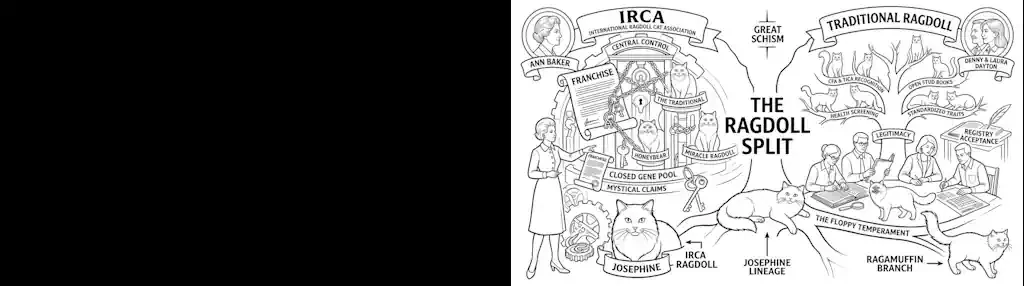
Unlike the Cat Fanciers' Association (CFA) or other established registries that functioned as non-profit bodies for the advancement of all breeds, the IRCA operated under a franchise system. This was a jarring departure from traditional "cat fancy" norms. Under the IRCA umbrella, breeders did not merely own cats; they were franchisees who signed restrictive legal contracts. These agreements dictated that breeders could only register their cats through the IRCA, were forbidden from crossing their lines with non-IRCA cats, and were often required to pay royalties back to Baker for every kitten sold. This structure was designed to ensure that the "Ragdoll" name remained synonymous with the specific physical and behavioral traits Baker had isolated, most notably the "floppy" reflex and the placid, trust-filled temperament that she claimed was a revolutionary step in feline evolution.
The internal culture of the IRCA was one of strict adherence to Baker’s specific "Traditional" standards. In these early years, the organization focused on a narrow set of criteria: the three primary patterns of Colorpoint, Mitted, and Bicolor, and a limited color palette of seal and blue. However, the IRCA was also the site of Baker’s more avant-garde experiments, including the development of "Miracle Ragdolls" and other offshoots like the "Honeybear." These experiments often blurred the lines between standard breeding and the creation of "designer" pets, further isolating the IRCA from the mainstream breeding community which viewed Baker’s marketing-heavy, business-first approach with significant skepticism.
Ultimately, the IRCA represented a closed ecosystem. By keeping her breeders and their cats isolated from the competitive show circuit and mainstream registries, Baker created a vacuum where her word was law. This centralization was both the strength and the eventual downfall of the association. While it allowed for the rapid, uniform establishment of the breed’s core traits, it also created a pressure cooker of resentment among breeders who sought the legitimacy of the wider feline world. The IRCA was the laboratory where the Ragdoll was refined, but it was also the cage from which the breed would eventually need to escape to achieve its global potential. The tension between Baker’s proprietary control and the desire for professional recognition would eventually trigger a schism that redefined the breed's future.
The Institutional Structure and the Franchise Paradox
The IRCA was built upon a foundation of absolute control, enforced through a legal and financial framework that was entirely foreign to the world of pedigreed cats. At the heart of this structure was a complex licensing agreement that effectively turned breeders into business affiliates rather than independent hobbyists. When a breeder entered the IRCA, they were not simply buying a cat; they were purchasing a right to use the trademarked "Ragdoll" name. These contracts were notoriously restrictive, often stipulating that every kitten born in an IRCA cattery had to be registered through Ann Baker’s personal office, with a fee, essentially a royalty, paid back to the association for each transaction.
This centralized authority created a hierarchy where Ann Baker sat as the sole arbiter of what constituted a "legitimate" Ragdoll. Unlike mainstream registries that utilize a board of directors or democratic voting systems to establish breed standards, the IRCA functioned as a benevolent, and occasionally litigious, dictatorship. Baker maintained the master stud books herself, keeping the primary records of the Josephine lineage under lock and key. This meant that any breeder who wished to prove their cat’s heritage was entirely dependent on Baker’s personal ledgers. The lack of transparency in these records often led to confusion, but it ensured that no one could claim to breed "True Ragdolls" without her explicit blessing and the associated financial contribution.
The franchise model also dictated how breeders could market their animals. Baker provided the promotional materials, the terminology, and the narrative that defined the breed. This included her specific claims about the cats’ unique physiology, such as their purported immunity to pain or their alien-like skeletal structure. Breeders were expected to parrot these "IRCA truths" to potential buyers, creating a unified, albeit scientifically questionable, brand identity. This enforced consistency was a double-edged sword: it created a recognizable brand that appealed to a public fascinated by the exotic, but it also made the IRCA an easy target for criticism from the wider veterinary and breeding communities.
Perhaps the most isolating feature of the IRCA structure was its prohibition on "outcrossing" or interacting with other registries. IRCA breeders were forbidden from showing their cats in organizations like the CFA or TICA, under the threat of losing their trademark license. Baker argued that the competitive show circuit would "ruin" the Ragdoll by prioritizing physical beauty over the essential "floppy" temperament. In reality, this policy served to keep the IRCA a closed economy. By preventing her breeders from seeking validation elsewhere, Baker ensured that the IRCA remained the only place where a Ragdoll owner could find community and recognition. This isolationist policy turned the association into a silo, protecting the breed in its infancy but ultimately stifling the professional growth of the individuals who were most passionate about its success.
Breed Standards and the Diversification of IRCA Variants
Under the IRCA, the definition of a Ragdoll was both rigid and paradoxically experimental. While Ann Baker was a fierce protector of the "traditional" trio, the Colorpoint, the Mitted, and the Bicolor, she also used the association as a laboratory for developing offshoot breeds that pushed the boundaries of the original Josephine line. This section of the IRCA’s history is marked by a tension between maintaining a specific aesthetic standard and a restless desire to expand the "brand" into new, even more exotic territory.
The "Traditional" IRCA Ragdoll was defined by a specific set of parameters that later became the blueprint for the entire breed. Baker insisted on the large, heavy-boned frame and the distinct "floppy" temperament as the primary standards. In terms of aesthetics, the IRCA focused heavily on the richness of the point colors, Seal and Blue being the foundational pillars, and the precise symmetry of the white markings in Mitted and Bicolor variants. However, Baker’s standards were often more descriptive than technical; she prioritized the "feel" of the cat and its psychological response to being held over the minute anatomical measurements favored by mainstream show judges.
As the 1970s progressed, Baker began to diversify the IRCA’s portfolio, introducing variants that she claimed were related to, but distinct from, the original Ragdoll. The most notable of these was the "Honeybear," a breed she marketed as having a thicker coat and an even more docile, almost sedentary nature. She also introduced the "Miracle Ragdoll," which featured non-traditional colors and patterns that fell outside the original scope of the pointed Himalayan gene. These variants were often used as a way to maintain market interest and offer "exclusive" lines to her franchisees, though they often created confusion within the breeding community regarding what truly constituted a "Ragdoll."
The IRCA also established the "Cherubim" classification, a broad umbrella term Baker used to describe the various experimental lines she was developing. Within the Cherubim group, she categorized cats into different "series" based on their coat color and personality traits. This internal taxonomy was complex and often changed at Baker’s whim, making the IRCA a confusing landscape for those used to the stable, slow-moving standards of other registries. Despite this volatility, the IRCA’s focus on temperament remained absolute. To be registered, a cat had to exhibit the signature "limpness." If a line began to show signs of high energy or independence, it was often relegated to a secondary tier or excluded from the "Ragdoll" designation entirely.
This era of the IRCA was characterized by a unique blend of strict traditionalism and wild experimentation. Baker was essentially attempting to create a "spectrum" of companionship, with the Ragdoll at the center and various "Cherubim" offshoots providing alternatives for different types of owners. While many of these experimental lines eventually faded into obscurity or were absorbed into other breeds, they represent the peak of the IRCA’s influence as an independent, self-contained universe of feline development. The standards established during this time, though often viewed through the lens of Baker’s personal eccentricities, formed the raw material from which the modern, globally recognized Ragdoll would eventually be carved.
The Great Schism and the Rise of the Traditionalists
By the mid-1970s, the restrictive atmosphere within the IRCA reached a breaking point. While Ann Baker’s centralized control had successfully launched the breed, her business practices and increasingly bizarre claims, ranging from the effects of radiation on Josephine to the cats’ "alien" heritage, began to alienate her most dedicated franchisees. The internal friction was primarily driven by a desire for legitimacy; serious breeders wanted the Ragdoll to be recognized as a peer to the Siamese or the Persian, a goal that was impossible so long as the breed remained a "franchise" locked in a proprietary vacuum.
The tipping point came in 1975, led by Denny and Laura Dayton. The Daytons, who had been among the first to purchase breeding stock from Baker, realized that the Ragdoll would never achieve global acceptance if it stayed tethered to the IRCA’s legal and reputational baggage. They led a group of defectors in a move that would be remembered as the "Great Schism." This group’s objective was to strip away the "franchise" labels and the pseudo-scientific mythology, focusing instead on the scientific tracking of pedigrees and the pursuit of recognition from mainstream registries like the Cat Fanciers' Association (CFA).
This departure was not merely a change in management; it was an ideological war over the identity of the breed. The Daytons founded the Ragdoll Fanciers' Club International (RFCI) as a democratic, non-profit alternative to Baker’s IRCA. To achieve mainstream recognition, they had to prove the Ragdoll was a stable, predictable breed with a documented lineage. They meticulously compiled the "Dayton Genetic Chart," a massive undertaking that traced the ancestry of every available Ragdoll back to the foundation cats. This chart became the backbone of the "Traditional" Ragdoll movement, providing the transparency that mainstream registries demanded and that Baker had always refused to provide.
The schism created a permanent divide in the Ragdoll world. On one side stood the IRCA, which continued to operate under Baker’s control, maintaining the franchise system and moving deeper into experimental "Cherubim" lines. On the other was the RFCI and the burgeoning mainstream community, which focused exclusively on the pointed, blue-eyed standards and professional show-bench quality. As the Daytons successfully gained recognition from one registry after another, the influence of the IRCA began to wane. The "Traditionalists" proved that the Ragdoll could stand on its own merits without the need for proprietary secrets, effectively liberating the breed from its creator and setting the stage for its eventual status as one of the most popular cats in the world.
The Decline of the IRCA and the Modern Legacy of Ann Baker
Following the departure of the Daytons and the rise of mainstream registries, the IRCA entered a period of gradual contraction and insularity. While the "Traditionalists" were busy winning ribbons and establishing a global footprint, Ann Baker doubled down on the proprietary nature of her association. Throughout the 1980s and 1990s, the IRCA became less of a breed registry and more of a sanctuary for Baker’s increasingly niche experiments. She continued to refine the "Cherubim" lines, creating a fragmented landscape of breeds like the Ragamuffin, which originally emerged from IRCA stock, and various "Miracle" variants that lacked the blue-eyed, pointed consistency of the mainstream Ragdoll.
The decline of the IRCA was accelerated by the natural progression of time and the evolving standards of the veterinary and scientific communities. Baker’s refusal to allow DNA testing or open-source pedigree tracking meant that IRCA cats were often viewed as "commercial" rather than "pedigreed" by the broader cat fancy. As Baker aged, her ability to maintain the rigorous franchise oversight she had once commanded began to falter. By the time of her passing in 1997, the IRCA had lost its status as the primary authority on the breed, and many of its breeders either retired or sought to "bridge" their lines into mainstream associations, a difficult task given the lack of transparent IRCA records.
However, it would be a mistake to view the IRCA as a failure. Its modern legacy is found in the very existence of the Ragdoll itself. Despite the controversy and the legal battles, Ann Baker’s IRCA acted as the essential "nursery" for the breed. It provided the protected environment where the unique traits of the Josephine lineage could be fixed and stabilized before being released to the wider world. The IRCA was the laboratory that proved a cat could be bred specifically for a "dog-like" temperament, a concept that is now a cornerstone of the multi-billion dollar companion animal industry.
Today, the IRCA exists primarily as a historical footnote, but its fingerprints are everywhere. Every "Traditional" Ragdoll registered with the CFA or TICA carries the DNA of the cats Baker first isolated and branded. The "limp" reflex, the substantial frame, and the social devotion that we now associate with the breed were all codified within the walls of Baker’s association. The IRCA was a polarizing entity, a mix of visionary breeding and restrictive commerce, but it remains the forge in which the "Gentle Giant" was shaped. Without the IRCA’s initial, aggressive gatekeeping, the Ragdoll might have simply faded into the obscurity of a neighborhood colony rather than becoming the global icon of feline trust it is today.
IRCA Commercialism vs. Traditional Standardization
The distinction between the IRCA Ragdoll and the Traditional Ragdoll is a study in divergent philosophies. Under the IRCA, the cat was treated as a proprietary invention rather than a standard biological breed. Ann Baker focused almost exclusively on behavioral traits, specifically the "floppy" muscle relaxation and a docile temperament, often at the expense of standardized physical traits. This led to a highly experimental environment where non-pointed colors, varied eye shades, and experimental sub-breeds like the "Honeybear" were all marketed under the same umbrella. Within this system, registration was a private, fee-based business transaction, and pedigrees were guarded as trade secrets rather than shared as public records.
The Traditional Ragdoll, spearheaded by the Daytons and the RFCI, represented a decisive move toward scientific and professional legitimacy. This faction stripped away the "franchise" labels and established the rigid standards we recognize today: the coat must be pointed, the eyes must be blue, and the lineage must be transparently documented through open stud books. While the IRCA prioritized the cat as a commercial product with flexible aesthetics, the Traditional movement treated the Ragdoll as a biological masterpiece that required strict, peer-reviewed standards to survive in the global cat fancy.
This ideological split eventually birthed the Ragamuffin. When mainstream registries refused to accept the non-pointed or "solid" colored cats from the IRCA lines, those breeders formed their own association to preserve that genetic diversity. This allowed the Traditional Ragdoll to remain a strictly blue-eyed, pointed breed, while the Ragamuffin became the home for the broader color palette and diverse patterns originally fostered by Baker. In essence, the Traditional Ragdoll is the refined descendant of Baker’s work, while the Ragamuffin is the inclusive descendant, both carrying the same legendary, placid temperament into the modern era.
The Evolution from Monopoly to Masterpiece
The history of the International Ragdoll Cat Association is ultimately a study of the friction between creation and community. While Ann Baker provided the architectural spark that brought the Ragdoll into being, the IRCA served as the rigid scaffolding that held the breed together during its vulnerable early years. It was an organization born of a singular will, functioning as a gatekeeper that ensured the "floppy" temperament and pointed aesthetics were not diluted by outside influences. However, the very walls Baker built to protect her creation eventually became the barriers that threatened to isolate it from the progress of feline science and professional recognition.
The legacy of the IRCA is best understood through the lens of transition. It moved the Ragdoll from a backyard curiosity in Riverside to a trademarked brand, and finally, through the pressure of the Great Schism, into a globally respected pedigreed breed. The association’s insistence on "temperament first" remains its most enduring contribution; even today, when breeders discuss the "IRCA type," they are referring to the soulful, docile nature that Baker prioritized above all else. Though the franchise model has long since faded, replaced by the transparent, democratic standards of modern registries, the spirit of the IRCA, that belief in a feline companion that mirrors human vulnerability and trust, remains the heartbeat of the breed.