The Foundation, The Himalayan Gene and Temperature-Sensitive Albinism
The entire visual identity of the Ragdoll cat is built upon a specific genetic foundation known as the Himalayan gene, or the cs allele. To understand why a Ragdoll looks the way it does, one must look past the fur and into the chemistry of pigment production. At the heart of this process is an enzyme called tyrosinase, which is responsible for the creation of melanin, the substance that gives hair and skin its color. In most cats, this enzyme works consistently across the entire body, regardless of external conditions. However, in the Ragdoll, a specific mutation causes this enzyme to become heat-sensitive. It effectively "breaks down" or becomes inactive at normal core body temperatures.
This biological quirk creates a phenomenon known as temperature-sensitive albinism. Because the cat’s torso and internal organs are the warmest parts of its body, the tyrosinase enzyme cannot function there, leaving the fur on the body creamy, white, or pale fawn. Conversely, the "points", the ears, nose, paws, and tail, are several degrees cooler than the rest of the body because they are further from the heart and have a higher surface-area-to-mass ratio. In these cooler zones, the enzyme remains stable and active, allowing melanin to be produced and deposited into the growing hair shafts. This is why a Ragdoll’s darkest colors are always found on its extremities, creating the high-contrast "masked" look that is the hallmark of the breed.
Furthermore, the Himalayan gene acts as a "mask" over the cat's true genetic color. Every Ragdoll is fundamentally a "Solid," a "Tabby," or a "Tortoiseshell" underneath its pointed pattern. For example, a Seal Point Ragdoll is genetically a solid black cat, but the cs gene restricts that black pigment only to the cooler points. Similarly, a Lynx Point Ragdoll is genetically a Tabby, but the stripes are only visible where the temperature is low enough for the pigment to manifest. This is also why Ragdolls are born pure white; the uniform warmth of the mother’s womb keeps the tyrosinase enzyme inactive across the entire kitten until it is exposed to the cooler air of the outside world.
The complexity of the gene pool deepens when discussing the "dilute" and "chocolate" variations. The colors we see, such as Blue or Lilac, are the result of additional modifier genes. The Blue Ragdoll is simply a Seal (black) cat with a "dilution" gene that clumps the pigment granules together, reflecting light in a way that appears grey-blue. The Lilac and Chocolate variations are even more recessive, requiring specific combinations from both parents to appear. Because these traits are governed by the same temperature-sensitive rules, a Blue or Lilac Ragdoll will always have a lighter body and softer points than their "dense" counterparts. Understanding this thermal-genetic relationship is the first step for any enthusiast or breeder in mastering the science behind the breed's ethereal beauty.
The White Spotting Series and the Genetic Spectrum
While the Himalayan gene provides the base pointed pattern, the white markings that define the Mitted and Bicolor varieties are governed by an entirely different set of rules known as the White Spotting Series. This gene is an incomplete dominant, meaning it does not just turn on or off like a simple light switch. Instead, it acts like a sliding scale or a biological dimmer switch. In the Ragdoll, we are specifically looking at how much of the cat’s natural pointed color is overwritten by white patches.
The genetic spectrum for white spotting is often measured on a scale from one to ten. A solid Colorpoint Ragdoll, which is a cat with no white at all, lacks the spotting gene entirely. As we move up the scale, the spotting allele begins to express itself. The Mitted pattern typically falls into the lower end of this range. Interestingly, the white paws and chin of a Mitted Ragdoll are not just random spots; they are governed by specific modifiers that fix the white to the extremities. This is what separates a pedigreed Mitted Ragdoll from a common stray cat with white socks. The Ragdoll's white is genetically stabilized to appear in a symmetrical, predictable fashion.
The Bicolor pattern represents a higher concentration of the white spotting gene, usually sitting near the middle of the scale. In a true Bicolor, the gene is aggressive enough to clear the pigment from the legs, the chest, and a specific triangular portion of the face, creating the iconic inverted V. However, because the gene is an incomplete dominant, the results are not always mathematically perfect. A cat might genetically be a Bicolor but physically express too much white, approaching what is known as the Van pattern, or too little, appearing as a High Mitted cat.
This genetic elasticity is why breeding for the Show Quality standard is so difficult. A breeder is not just trying to get the right gene; they are trying to hit a specific point on a very slippery spectrum. If a kitten inherits a high-expression version of the spotting gene from both parents, it may end up at the extreme end of the scale. These cats are mostly white with only small patches of color on the head and tail. While these Van patterned cats are genetically useful for breeding programs, they often fall outside the Traditionalist show standards, which demand the balanced, symmetrical mask and saddle of the standard Bicolor.
The Architecture of the Bicolor, True Bicolor vs. High Mitted
One of the most complex challenges for serious enthusiasts is distinguishing between a True Bicolor and a High Mitted cat. Physically, these two cats can look almost identical to the naked eye, both featuring white legs and a white facial blaze. However, genetically, they are worlds apart. A True Bicolor carries one version of the spotting gene and one version of the non-spotting gene. A High Mitted cat, on the other hand, is often the result of breeding two Mitted cats together where minor helper genes, known as polygenes, have pushed the white expression further than usual.
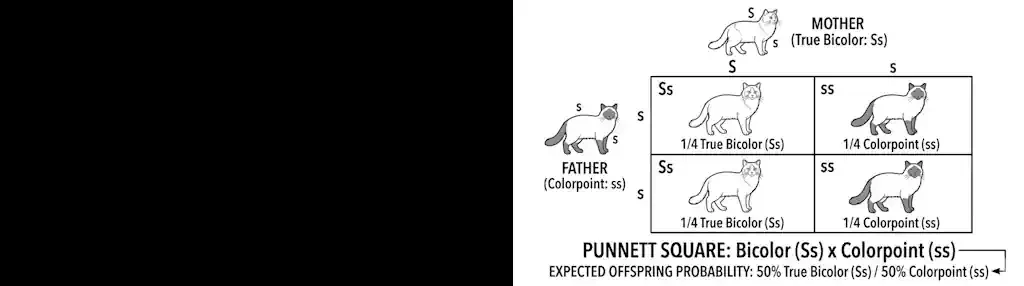
The distinction becomes critical when these cats are used in a breeding program. If you breed a True Bicolor to a Colorpoint, you have a fifty percent chance of producing more Bicolors. If you breed two True Bicolors together, you risk producing High White or Van kittens because the kittens may inherit the spotting gene from both parents. This double dominant status creates a cat that is nearly all white, lacking the classic mask required by the major cat associations.
Furthermore, the V on a Bicolor’s face is a masterpiece of genetic architecture. The symmetry required for a show-quality cat, where the white does not extend past the outer corners of the eyes and the nose leather remains pink, is influenced by polygenes. These are unmapped, minor genes that act like fine-tuners for the primary spotting gene. A cat may have the correct Bicolor gene but lack the polygenetic tuning to make the mask symmetrical. This is why even a pairing of two perfect show-quality parents can produce a litter of pet quality kittens with lopsided masks or runs of color down their legs. In the world of Ragdoll genetics, the primary gene provides the frame of the house, but the polygenes decide exactly where the windows are placed.
The Breeder’s Dilemma, Statistical Probability
Predicting the perfect mask is perhaps the most daunting challenge in Ragdoll breeding. Because the white spotting gene is so fluid, even the most carefully planned pairings are subject to the laws of probability. When a breeder aims for a "Show Quality" Bicolor, they are essentially looking for a specific heterozygous balance. If you breed a True Bicolor to a Colorpoint, the Punnett square suggests a fifty-fifty split of Bicolor and Colorpoint kittens. However, the physical expression of that Bicolor gene is where the gamble begins.
The "Perfect Mask" requires the white inverted V to be symmetrical, centered, and contained within the inner and outer corners of the eyes. Mathematically, this is difficult because the spotting gene does not distribute white pigment with clinical precision. It spreads like spilled milk across a surface; sometimes it flows perfectly into the facial wedge, and other times it "runs" into the ears or leaves a "smudge" of color on the nose. These minor deviations, while not affecting the health or temperament of the cat, disqualify it from the high-level show ring and categorize it as "Pet Quality."
The "Heterozygous Advantage" is a term breeders use to describe why they often avoid breeding two Bicolors together. While it might seem logical to pair two perfect Bicolors to get more of the same, the result is often the "Double Dominant" or "High Van" kitten. These kittens inherit a "dose" of the white spotting gene from both parents, which effectively wipes out most of the color on the body. While these High Van cats are mathematically fascinating and useful for "Colorpoint-to-Van" pairings (which statistically produce 100% Bicolors), they do not meet the aesthetic standard of the Traditional movement.
Finally, the role of polygenes adds a layer of "invisible" probability. These are clusters of minor genes that influence the "crispness" of the markings. A lineage known for "clean" Bicolors likely has a strong set of these unmapped modifiers. Without them, even a genetically "correct" Bicolor may have ragged edges to its mask or "bleeding" of color into the white chest. For the serious enthusiast, understanding these probabilities transforms the Ragdoll from a mere pet into a living puzzle of genetic architecture.
Genetic Health Testing, Beyond the Mask
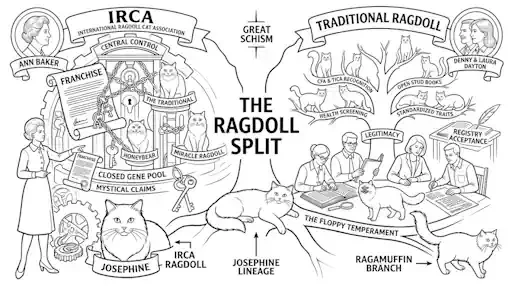
While the IRCA era was defined by mystery and "closed books," the modern era of the Ragdoll is defined by transparency and molecular biology. The most significant advancement in the breed’s history is the isolation of the DNA mutation for Hypertrophic Cardiomyopathy, or HCM. This is a condition where the heart muscle thickens, and in Ragdolls, it is linked to a specific mutation in the MYBPC3 gene. Genetic testing allows breeders to identify if a cat is "Clear," "Heterozygous" (carrying one copy), or "Homozygous" (carrying two copies) for this mutation.
By utilizing these tests, the modern breeder has been able to virtually eliminate the risk of early-onset heart failure that plagued some of the early IRCA lines. A responsible breeding program today only uses "HCM Clear" cats, ensuring that the mutation is not passed down to future generations. This is a stark contrast to the early decades of the breed, where breeders had to rely on luck or the "survival of the fittest" to maintain the health of their colonies. Today, a simple cheek swab provides more information than a decade of observation ever could.
Similarly, testing for Polycystic Kidney Disease (PKD) has become a standard requirement. While Ragdolls are not as prone to PKD as some other long-haired breeds, the "Legitimacy" movement established by the Daytons insisted on total health transparency. Genetic screening has replaced the need for frequent and expensive ultrasounds, allowing breeders to guarantee the internal health of their kittens as confidently as they guarantee their "floppy" temperament.
The future of the Ragdoll lies in this marriage of aesthetics and science. We are moving toward a time where we may be able to map the exact polygenes responsible for the "Perfect Mask" or the specific "Mitten" modifier. For now, the combination of the Himalayan gene, the White Spotting series, and rigorous health DNA testing remains the gold standard. The Ragdoll is no longer a product of "mystical claims" or "proprietary patents"; it is a scientifically documented masterpiece of feline evolution.
Frequently Asked Questions: Advanced Ragdoll Genetics
Is a "High Mitted" cat the same as a Bicolor?
No. While they may look similar, a High Mitted cat is genetically a Mitted cat with "excessive" white, while a Bicolor carries the specific Bicolor spotting gene. Their offspring will follow different genetic patterns.
Why are my Ragdoll's points getting darker in the winter?
Because of the Himalayan gene! Cooler temperatures allow the pigment-producing enzyme to work more effectively, which can cause the points to deepen or the body coat to "smut" (darken) during cold months.
What does "Homozygous" mean in a health test?
It means the cat has two copies of a specific gene (one from each parent). If a cat is homozygous for a negative trait like HCM, they are at a much higher risk for the disease and should never be used in a breeding program.
Can two Colorpoint parents produce a Bicolor kitten?
No. The white spotting gene is dominant. At least one parent must be Mitted or Bicolor to produce a kitten with white markings. If two Colorpoints produce a white-spotted kitten, there is likely a mistake in the pedigree records.
What is the "Van" pattern?
The Van pattern is the extreme end of the white spotting scale. These cats are mostly white, with color only on the top of the head and the tail. They are often the result of breeding two Bicolors together.