The Blank Canvas, The Science and Mystery of the Birth
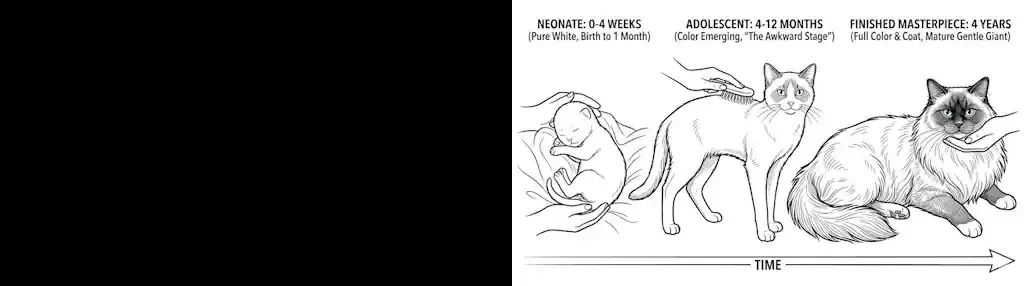
The birth of a Ragdoll kitten is a study in biological suspense. Unlike many other breeds that arrive with their coat patterns already defined, a newborn Ragdoll is a "blank canvas", pure, snowy white from nose to tail. This phenomenon is not accidental but is rooted in a fascinating form of temperature-sensitive albinism. Every pedigreed Ragdoll carries the Himalayan gene, a specific mutation of the tyrosinase gene that regulates melanin production. In the constant, life-sustaining warmth of the mother’s womb, this gene remains "switched off," preventing the development of pigment. It is only after birth, when the kitten is exposed to the cooler temperatures of the external world, that the genetic machinery begins to react, slowly painting the fur in the areas where the body heat is lowest.
During the first week of life, this transition is nearly invisible to the untrained eye. The kitten remains a pristine white, but the biological clock is already ticking. Because the ears, nose, and tail are the furthest points from the heart and maintain the lowest surface temperature, they are the first "canvaries" for color. By the end of the first ten days, a keen observer might notice a faint, ghost-like "smudge" on the leather of the nose or the very tips of the ears. These early shadows are the first indicators of whether the kitten will eventually be a deep Seal, a soft Blue, or perhaps a Lilac or Chocolate. At this stage, the pigment is so subtle it often resembles a slight bruising or a dusting of soot rather than a defined coat color.
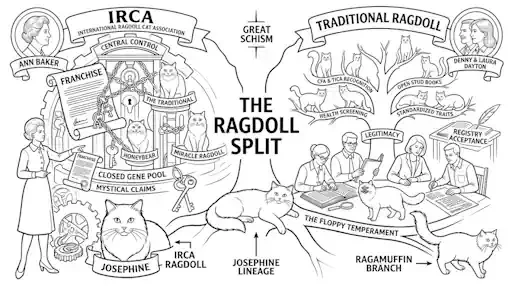
Beyond the physical aesthetics, the first four weeks are also when the foundational "floppy" temperament begins to manifest. While all kittens are somewhat uncoordinated, Ragdolls demonstrate a unique muscular yielding even as neonates. When a two-week-old Ragdoll is lifted from the nesting box for a health check, they do not typically display the rigid, defensive "scrabble" common in more high-strung breeds. Instead, they exhibit a nascent version of the limpness that defined the Josephine lineage. This is a critical period for the breeder to begin "gentle handling" protocols, short, frequent sessions of cradling the kitten on its back and touching its paws. This early human intervention works in tandem with their genetic blueprint to ensure that the kitten’s default response to human contact is one of total, boneless surrender.
As the first month draws to a close, the "blank canvas" phase begins to fade. The ears have likely taken on a distinct hue, and the "mask" on the face is starting to creep inward from the cheeks toward the eyes. The kitten is no longer a generic white ball of fur; it is beginning to claim its identity. For the owner or breeder, this period is a lesson in patience, as the Ragdoll’s full color saturation is a journey that will take years to complete. The birth is merely the prologue to a multi-year metamorphosis that turns a simple white kitten into a masterpiece of feline architecture and color.
The Shifting Palette, Color Definition and the Sapphire Gaze
As the kitten enters its second month, the "ghostly" smudges of the first few weeks sharpen into the definitive patterns that categorize the breed. This is the stage where a breeder can finally distinguish between a Colorpoint, a Mitted, and a Bicolor. The Pointed gene begins to concentrate pigment on the extremities with increasing intensity, and the white masking genes, if present, begin to carve out the specific "flash" on the face or the "boots" on the paws. For a Bicolor kitten, the iconic inverted "V" on the face starts to appear as a crisp, white wedge against a darkening mask, while the Mitted kittens reveal their signature white chin and the precise white "mittens" on their front feet.
Simultaneously, a dramatic transformation occurs in the eyes. All kittens are born with a cloudy, neonatal blue, but in most breeds, this settles into green, gold, or copper by week eight. The Ragdoll, however, is genetically bound to its sapphire heritage. During this transition, the cloudy film clears, revealing the permanent depth of the blue. The intensity can vary from a pale sky blue to a startlingly deep violet-blue, but the presence of this color is an absolute requirement for the breed standard. This "sapphire gaze" is more than just an aesthetic trait; it is a visual hallmark of the temperature-sensitive albinism that defines their entire physical makeup.
This period also marks the opening of the critical socialization window. Between weeks five and twelve, the Ragdoll kitten is a cognitive sponge, and their legendary temperament is solidified through intentional human interaction. Because they lack the sharp "fight or flight" instincts of more primitive breeds, they are uniquely vulnerable to negative experiences. Breeders focus on "gentle handling" protocols, cradling the kittens on their backs, massaging their paws to prepare them for future nail trimmings, and exposing them to the common sounds of a busy household. This is when the kitten learns that the human hand is a source of security, not a threat, reinforcing the "floppy" reflex that will stay with them for life.
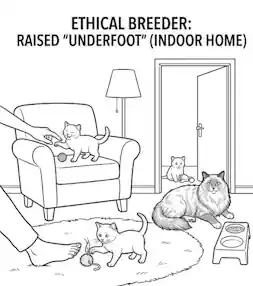
By the end of the third month, the kitten’s personality begins to diverge from the generic playfulness of infancy. While they still engage in the typical "zoomies," the Ragdoll's play is often characterized by a certain groundedness. They are less likely to be found scaling the curtains and more likely to be found underfoot, following their human partner from room to room with a quiet, observant devotion. The "blank canvas" of birth has been replaced by a clearly defined individual, possessing the striking blue eyes and the budding coat patterns that make the Ragdoll one of the most recognizable and coveted companions in the world.
The Adolescent Spurt, The "Colt-Like" Middle Phase
Between four and twelve months, the Ragdoll enters its most physically disproportionate stage. This is the "adolescent spurt," where the kitten’s skeletal frame often outpaces its muscular development and coat growth. A Ragdoll in this phase can look remarkably "colt-like", long-legged, high-hipped, and occasionally a bit thin despite a ravenous appetite. Because they are a large-breed cat, their bones are denser and their growth plates stay open longer than those of a standard domestic cat. Owners often notice a sudden "stretch" in the torso or a heightening of the hindquarters that can make the cat appear temporarily uncoordinated or "gangly."
Nutrition during this window is the most critical factor in ensuring long-term health. A Ragdoll kitten can gain as much as a pound per month during peak growth, requiring a high-protein, calorie-dense diet to fuel the construction of heavy bone and lean muscle. This is not the time for restrictive feeding; a growing Ragdoll needs the structural building blocks provided by premium kitten formulas, often supplemented with wet food to ensure proper hydration. This massive intake of energy is what prevents the lethargy sometimes mistaken for the breed's natural docility; a healthy adolescent should still have "zoomies," even if they are a bit more heavy-footed than a sleek Oriental breed.
The coat also begins a significant transition during this period. The fine, cottony "kitten fuzz" starts to shed, replaced by the beginnings of the adult silken texture. While the full ruff and "britches" are still months or even years away, the fur along the spine and tail begins to thicken and take on a more resilient, rabbit-like feel. This is the ideal time to establish a grooming routine. Even if the adolescent coat isn't prone to matting yet, daily brushing desensitizes the cat to the tools they will require for the rest of their lives. By the end of the first year, the frame is largely established, even if the "filling out" process has only just begun.
The Deepening Hue, Maturation of Color and Coat
The transition from the gangly, high-speed energy of kittenhood into the measured grace of a young adult occurs between one and two years of age. During this period, the Ragdoll’s physical appearance undergoes a subtle but profound shift. While the skeletal frame has largely reached its adult length, the cat now begins the process of "filling out." The chest widens, the heavy boning of the legs becomes more apparent, and the cat loses its colt-like awkwardness in favor of a more powerful, substantial presence. This structural settling is accompanied by the final evolution of the coat's texture. The silk-like, rabbit-soft fur that defines the breed reaches its full density, and the "ruff" around the neck and the "britches" on the hind legs begin to bloom into their plush, signature glory.
Crucially, this is the stage where the point colors achieve their true, intended depth. Because the Himalayan gene is temperature-sensitive, the pigment in the "points", the face, ears, tail, and legs, continues to darken as the cat matures and its peripheral circulation patterns stabilize. A Seal Point that appeared as a dusty, charcoal grey at six months may now reveal a rich, dark espresso hue, while a Blue Point settles into its definitive slate-grey tone. This darkening process is highly influenced by the cat's environment; Ragdolls living in cooler climates often develop darker, more intense point colors and a slightly thicker undercoat than those in warmer regions. The contrast between the cream-colored body and the dark points becomes sharp and dramatic, creating the iconic "masked" look that is the breed's visual calling card.
Behaviorally, the one-to-two-year window is when the impulsive "kitten energy" finally yields to the serene, observant nature of the adult Ragdoll. They become less prone to frantic "zoomies" and more focused on their role as a "floor rug" or devoted lap companion. They have learned the rhythms of the household and are now fully integrated into the family dynamic, often acting as a silent shadow to their favorite human. It is essential during this year to monitor their weight with extreme care; as their metabolism slows down from the frantic pace of infancy, their massive frames can easily hide the early onset of obesity. Maintaining a "heavy but lean" feel is the goal, ensuring that the structural integrity of the "Gentle Giant" remains uncompromised as they approach their full physical peak at age four.
As the second year concludes, the Ragdoll is no longer a work in progress but a masterpiece nearing completion. The coat is resilient, the eyes are a steady sapphire, and the "floppy" reflex is a deeply ingrained response to human touch. The cat has moved beyond the "blank canvas" of birth and the "sketch" of kittenhood, standing now as a fully realized portrait of its lineage. This is the stage where the owner's investment in high-quality nutrition and consistent socialization pays its greatest dividends, resulting in a cat that is as temperamentally stable as it is physically magnificent.
The Finished Masterpiece, Full Maturity at Age Four
The final stage of the Ragdoll’s development is a slow, deliberate burn that culminates around the fourth year of life. This is one of the few domestic breeds that requires such an extended period to reach full biological maturity, a fact that often catches first-time owners by surprise. By this point, the "fat pad" on the lower abdomen, a specific breed characteristic designed to protect the internal organs, is fully developed, and the cat has reached its maximum skeletal weight. For males, this can mean a staggering 15 to 20 pounds of solid muscle and heavy bone. The gangly shadows of kittenhood are entirely gone, replaced by a massive, powerful silhouette that is as soft to the touch as it is substantial to hold.
The coat is now at its absolute peak of magnificence. The silken guard hairs have reached their maximum length, and the ruff around the neck has filled out into a lion-like mane that frames the head. Because the Ragdoll lacks a thick, woolly undercoat, this long fur remains surprisingly easy to manage, but at four years old, it requires a disciplined grooming routine to maintain its tangle-free state. The "floppy" reflex is no longer a novelty but a deeply ingrained personality trait; the adult Ragdoll is a master of relaxation, offering a level of calm that anchors the entire home. When picked up, they do not merely yield; they collapse into the arms of their human partner with a total, boneless surrender that is the ultimate expression of feline trust.
The eyes, which began their journey as cloudy blue dots in a white face, are now deep, clear sapphire pools that reflect a lifetime of social integration. At four years old, the Ragdoll is no longer "developing", it is a finished masterpiece of selective breeding. The journey from a pure white, helpless neonate to a massive, colorful, and devoted companion is complete. The owner’s patience over these four years is rewarded with a pet that is not just a cat, but a significant presence in the house, a living testament to the beauty of a slow, steady transformation. The Ragdoll is now in its prime, ready to provide a decade or more of the unparalleled, dog-like companionship that only a "Gentle Giant" can offer.
Frequently Asked Questions: Ragdoll Development
Why is my one-year-old Ragdoll still so skinny?
Ragdolls grow in "spurts." Between 6 and 18 months, they often put all their energy into bone length rather than muscle mass. They typically don't "fill out" and gain their full breadth until their third or fourth year.
When will my kitten's eyes stop changing color?
The permanent shade of blue is usually established by three to four months of age. While the intensity may deepen slightly as the cat matures, the primary hue is set early in the kitten's development.
Can I speed up the color development of the points?
No. Point color is determined by genetics and body temperature. Keeping a cat in a very cold room may darken the coat slightly, but the natural darkening process is a multi-year journey that cannot be rushed.
Is the "belly fat" normal?
Yes. A small primordial pouch or "fat pad" on the lower belly is a recognized trait of the breed. However, it should not be confused with obesity; you should still be able to feel your cat's ribs under their plush coat.
How do I know if my Ragdoll is fully grown?
When the coat has reached its full length (including a prominent ruff) and the cat has maintained a consistent weight for six months after age three, they are likely at full maturity.